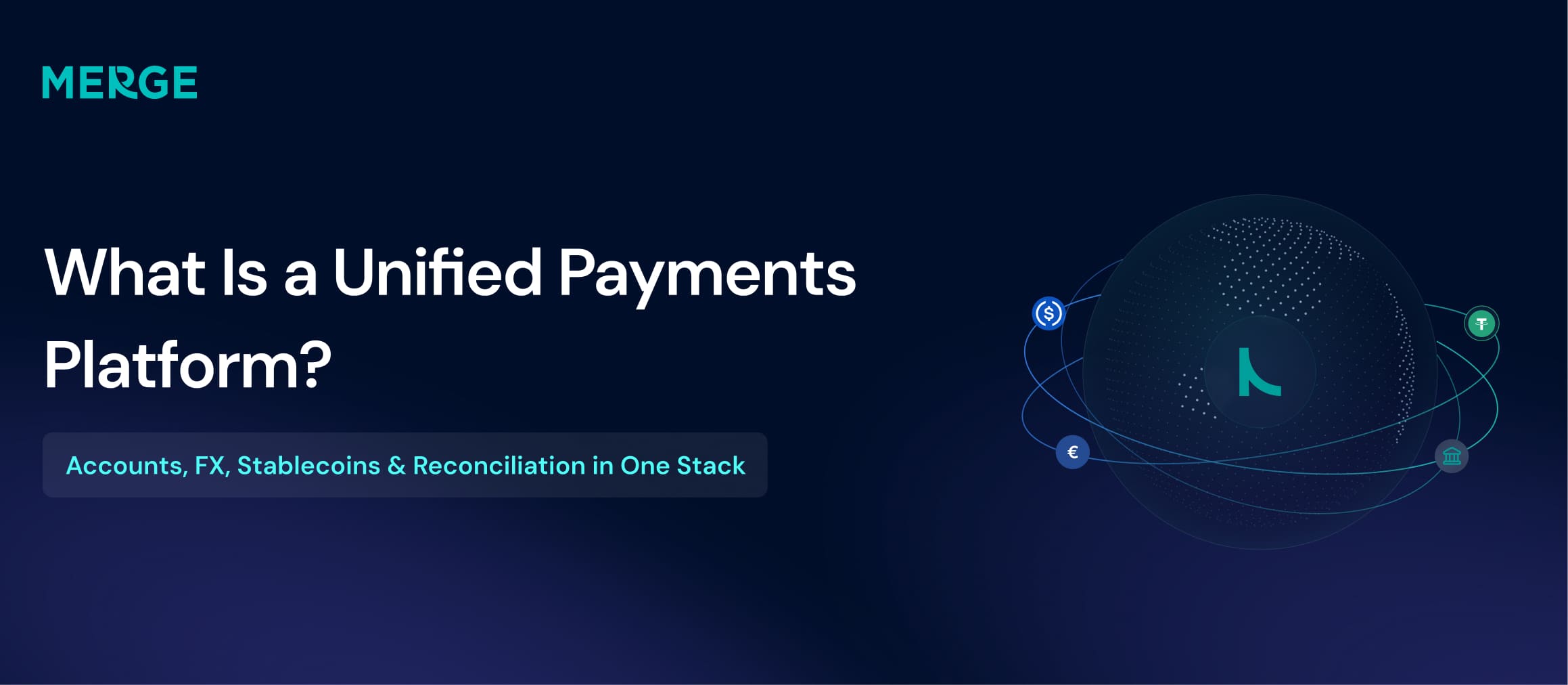


What Is a Unified Payments Platform? Accounts, FX, Stablecoins and Reconciliation in One Stack
- One operating stack connects accounts, collections, FX, settlement, payouts and reconciliation through one integration.
- It gives payment, finance and operations teams a shared view of each transaction, from funding to payout and ledger matching.
- It does not remove provider checks, compliance controls, treasury decisions or the company’s own accounting policy.
A unified payment platform is software and infrastructure that connects payment accounts, FX, collections, settlement, payouts and reconciliation in one operating layer. It cuts the need to manage a bank portal, FX provider, payout service and separate data feeds for each cross-border payment flow.
The real gain is not a prettier dashboard. It is one payment record that stays intact from instruction to ledger match.
What Is a Unified Payment Platform?
A growing payments business rarely starts with one neat stack. It adds a collection provider for one market. Then it adds an FX service, a local payout partner and more bank accounts. Each tool can work well alone. Trouble starts when a client asks why one payment is late.
The answer may sit across five systems. One uses an internal payment ID. Another records only the bank reference. The FX file has a conversion ID. The payout partner has its own status codes. Finance then joins those records by amount, date and counterparty, often in a spreadsheet.
A unified payments layer keeps those stages connected. It can cover:
- multi-currency accounts and customer collections
- payment instructions and routing rules
- FX quotes and conversion records
- stablecoin settlement routes, where supported
- local and cross-border payouts
- payment states, webhooks and exception data
- reconciliation records and finance-ready reports
This scope is broader than a payment gateway. A gateway usually collects payment details and sends an authorisation request. A payment orchestration platform coordinates providers, routes and data across a wider payment lifecycle. A unified layer extends that control into accounts, conversion, settlement, payout and finance records.
“Unified” does not mean one company performs every regulated task in every country. Banks, liquidity providers, local rails and regulated entities still have defined roles. The business gets one control layer and a clearer record of those hand-offs.
Why Do Businesses Need Unified Payments?
Fragmentation creates more than engineering work. It creates ambiguity. The same transfer can appear funded in one system, settled in another and missing in the recipient’s account.
Common problems include:
- different identifiers for the same payment
- inconsistent status names across providers
- fee and FX data held in separate files
- delayed webhooks or missing return reasons
- manual payout tracking across local rails
- weak visibility across entities and countries
- month-end matching based on amount and date
- longer investigations for returns and failed payments
The policy direction supports this operational focus. The Financial Stability Board’s G20 targets call for 75% of wholesale cross-border payments to be credited within one hour by the end of 2027. They call for those payments to be reconciled by the end of the day they are credited.
Data quality is part of that target. The Bank for International Settlements identifies limited interoperability as a binding constraint on cross-border payments. It calls for greater harmonisation of message standards. One API helps only when it presents consistent fields, states and identifiers. A thin connector over inconsistent records leaves much of the work untouched.
This is why good payment platform software needs a shared data model. It must answer four questions without a manual search: What did the business instruct? What happened to the money? What did it cost? What still needs review?
What Does a Unified Payment Flow Look Like?
The operating flow is simple to draw:
Sender → collection account or rail → payment instruction → FX or conversion → settlement route → local payout → reconciliation and reporting
The hard part lies in the joins. Each stage needs to pass its identity, amount, currency, time and status to the next stage.
1. Accounts and Collections
Funds enter through a local account, bank transfer, card flow or another supported payment method. The collection record should identify the payer, currency, amount, value date and business reference. Named accounts or sub-accounts can separate money by entity, seller, counterparty or cost centre at source.
That structure matters. Matching a payment to a dedicated sub-account is more reliable than guessing from a free-text reference. Multi-currency accounts can keep balances in their original currency, subject to product and jurisdiction terms. A euro receipt can fund a euro payout without an automatic round trip through sterling or dollars.
2. Payment Orchestration
The routing layer reads the instruction and chooses an available path. Rules can reflect currency, destination, payment type, cost, cut-off time and provider availability. The payment orchestration platform should keep the original business ID across every route. A provider change should not break the audit trail.
This is where an all-in-one payment platform earns its name. It coordinates the hand-offs, yet it still shows which provider, legal entity and corridor handled each stage.
3. FX and Conversion
Foreign exchange payments need more detail than “converted”. The record should show:
- source and destination currency
- quoted and converted amounts
- rate and fee
- quote time and execution time
- fee payer
- treatment after a failure or return
Timing matters. A quote can expire before funding arrives. A payout can fail after conversion. The system then needs a clear rule for holding, returning or converting funds again. It should record any new rate and fee as a separate event. It should never overwrite the first conversion.
Claims about the “best” or “lowest” rate hide these details. Terms differ by corridor, currency, size and provider. A useful record shows the rate available at execution and the final amount delivered.
4. Stablecoin Settlement
Stablecoins can sit inside the settlement layer for selected routes. A common fiat-to-fiat flow looks like this:
Local fiat collection → approved conversion → stablecoin transfer → approved conversion → local fiat payout
The sender and recipient do not need to handle a token in that design. The stablecoin carries value between the entry and exit points. Merge explains this model in its stablecoin on- and off-ramp guide.
There are several clocks, not one. Funding has a time. Screening has a time. Conversion has a time. The blockchain records confirmation. Redemption and local payout have their own times. A fast on-chain event does not prove that local currency reached the recipient.
A route review should cover the legal entity, stablecoin, network, conversion provider, liquidity, screening and payout rail. Stablecoins are not required for every corridor. A stablecoin payments API is useful where it joins those parts to a traceable fiat entry and exit flow.
5. Payouts
The payout stage sends the agreed currency through a local rail. Its state should distinguish submission, acceptance, settlement, rejection, return and confirmed delivery, where the rail provides that evidence.
This distinction matters in traditional flows too. SWIFT states that it carries messages between institutions. It does not hold assets, clear payments or settle transactions. A message status and a recipient credit are different events.
A cross-border payments platform should preserve both events. It should show which party owns the next action after a rejection, a closed beneficiary account or a compliance hold.
6. Reconciliation and Reporting
Reconciliation connects the external money movement to the company’s own books. The platform should return payment status, amounts, fees, references and exception data to the internal ledger or finance system.
Good payment reconciliation software links six records:
A platform is not fully unified if finance staff still reconstruct that chain across several systems at month end. Nor should a vendor claim to perform the client’s accounting. The platform supplies structured records and matching hooks. The client sets its ledger rules, materiality thresholds and review process.
How Do Multi-Currency Accounts Fit into the Stack?
Accounts give the flow a place to start, pause and separate funds. They can support local collections, working balances and payouts from connected rails. Named accounts can make each payer or business flow easier to identify.
They do not remove every local banking relationship. Availability depends on the currency, entity, use case and jurisdiction. Safeguarded e-money is not the same legal product as a bank deposit. Buyers should check the provider’s entity, account structure and protection terms.
What Should Businesses Look For?
Buyers should test the operating model, not the homepage. Use one real flow and ask for the records produced at each stage.
- One connected API: Can the same integration cover collections, FX, settlement and payouts?
- Stable identifiers: Does one business payment ID survive provider and route changes?
- Clear states: Are funded, converted, confirmed, paid, failed and returned separate statuses?
- Structured events: Do webhooks include timestamps, reason codes and replay support?
- Currency coverage: Which collection, holding, conversion and payout currencies are live for your entity?
- FX evidence: Can finance see the quote, rate, fee, execution time and delivered amount?
- Exception control: Can teams assign review rules without losing the original payment trail?
- Provider transparency: Which entity and provider handles each corridor and regulated task?
- Audit access: Can data flow into the company’s ledger, ERP and reporting tools?
- Security controls: Are roles, approvals, limits and logs available at the right level?
- Payment reconciliation software: Does it send clean records into the finance tools your team already uses?
Run a failure test too. Use an expired FX quote, rejected beneficiary or missing webhook. A cross-border payments platform proves its value in the exception path, not only on a successful transfer.
The same test separates useful payment platform software from a collection of branded endpoints. Ask for a sample payload from instruction through return. Check field names, identifier continuity and timestamps. Then ask finance to trace it without opening another portal.
How Merge Supports Unified Payments
Merge connects account infrastructure, FX, stablecoin settlement routes, local payment rails and reconciliation data through one API. Its developer page describes REST endpoints, JSON records and a webhook for each state change. Its stablecoin orchestration layer connects conversion, routing, on-chain settlement, local delivery and records across the flow.
That structure can give payment, finance and operations teams a shared operating view. It does not transfer the client’s payment policy, accounting treatment, provider oversight or regulatory duties to the software.
Teams assessing Merge can map a current process against its international business payments model. The useful question is concrete: Which portals, files and manual joins disappear for this corridor?
Start with One Payment Flow
Do not begin with a global replacement programme. Pick one recurring flow, such as supplier payments, marketplace seller payouts, contractor payments, collections or treasury transfers between two markets.
Measure six things before and after the change:
- time from instruction to recipient payout
- total FX cost and variance
- payment success and return rates
- number of provider hand-offs
- automatic reconciliation match rate
- time spent resolving each exception
This baseline makes the business case testable. It can reveal that the main delay sits in beneficiary credit, funding or internal approval, not settlement. It can show that data consistency saves more work than raw transfer speed.
A unified payment platform works best as a control and data layer around real providers, rails and regulated roles. That is the point of unified payments. The business gains one route to operate and explain the full payment journey, without pretending the underlying duties have disappeared.
To assess one corridor, book a payments architecture assessment or explore Merge’s API.
FAQ
What is a unified payment platform?

It is software and infrastructure that connects accounts, collections, FX, settlement, payouts and reconciliation in one operating layer. It gives teams one integration and a consistent payment record across the full flow.
What is the difference between a payment gateway and a unified payment platform?
A gateway sends payment data for authorisation, often at checkout. The broader platform coordinates accounts, routing, currency conversion, settlement, local payout, status data and reconciliation.
Can one platform manage accounts, FX and payouts?
Yes, one control layer can manage those functions through connected providers and rails. Coverage still varies by entity, corridor, currency and regulated service.
How do stablecoins fit into a unified payment stack?
They can carry value inside the settlement stage. A business can collect fiat, convert through an approved route, transfer on-chain, convert again and pay the recipient through a local rail. On-chain confirmation does not equal final local payout.
Does an all-in-one payment platform replace a bank account?
No. It can provide payment accounts or connect existing ones, subject to jurisdiction and product terms. Many businesses retain bank relationships for other activities.
Disclaimer: This content is intended for informational purposes only. It should not be considered financial, legal, or operational advice. Businesses should evaluate their own compliance, regulatory, and infrastructure requirements before implementing payment solutions.


Ready to see what Merge can do for you?
Related Articles