

Payment Settlement vs Payment Processing: Where Cross-Border Payments Actually Slow Down
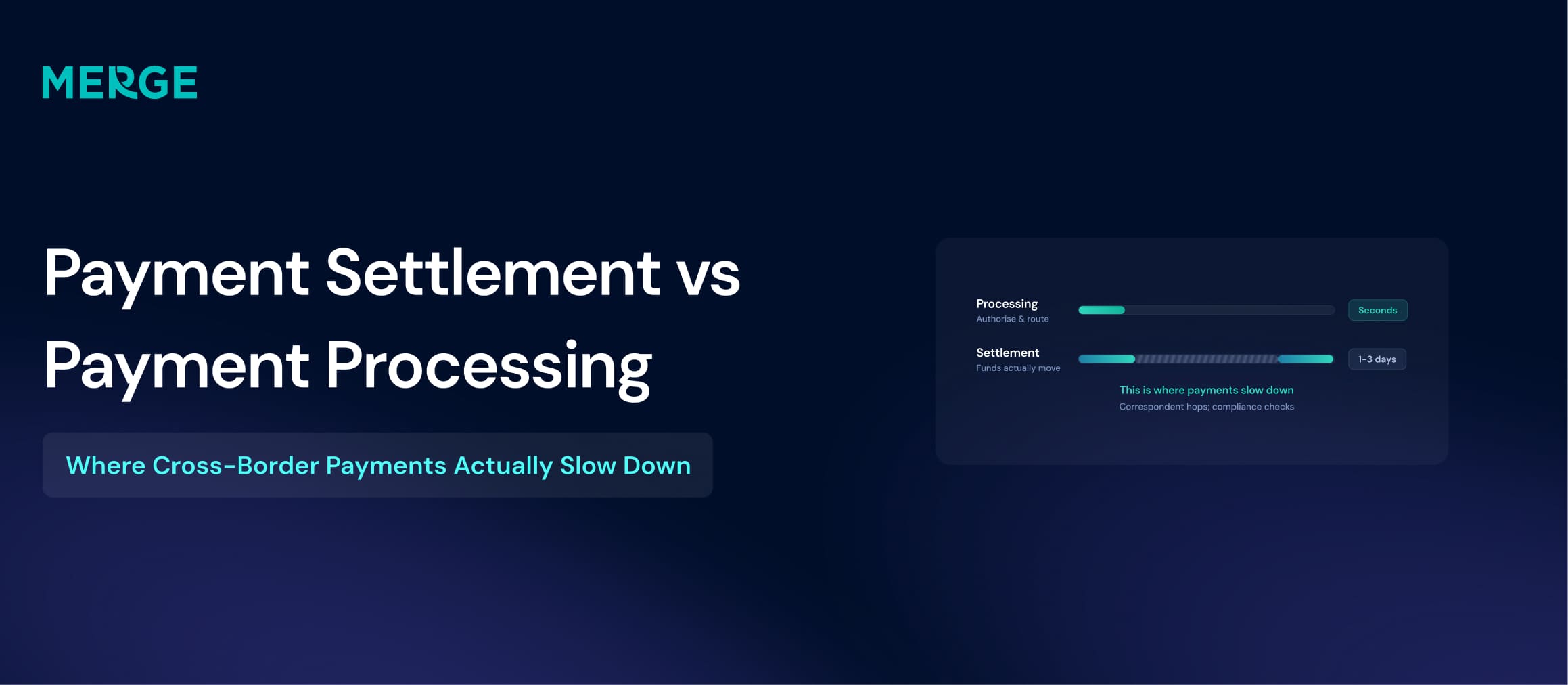
- Processing checks, routes and prepares an instruction. Settlement moves and records the money.
- A payment can clear one stage, then wait for FX, screening, payout or ledger matching.
- Track each stage separately. “Sent”, “settled” and “available” describe different events.
A business sends an overseas supplier payment. Its dashboard soon says “processed”. Two hours later, the supplier still has no funds.
Payment processing validates, screens and routes the payment. Payment settlement moves value between parties and records that movement. Cross-border delays often sit outside the first instruction. Funding, FX, compliance checks, local payout and reconciliation can each hold up delivery.
That distinction matters. A quick message or on-chain confirmation does not prove that the recipient can use the money.
What Is Payment Processing?
This stage covers the work performed on a payment instruction. The platform receives the instruction, validates the data and checks the permitted route. It can then run customer, business, sanctions and fraud checks.
For an international transfer, it can cover:
- receipt of the payment instruction
- account, beneficiary and payment-purpose checks
- customer and business verification
- sanctions and fraud screening
- approval rules and payment limits
- provider or rail selection
- status updates and exception handling
The processing decision answers one practical question: can this payment proceed? An approval says that the instruction passed the relevant checks at that point. It does not prove receipt.
International payment processing often crosses several systems. Each system can use its own status names. One provider’s “complete” can mean “instruction accepted”. Another can reserve that word for recipient delivery. Buyers of international payment processing services need the provider’s exact status definitions.
What Is Payment Settlement?
Payment settlement is the transfer and recording of value between the relevant parties. The CPMI payments glossary treats payment, clearing and settlement as distinct parts of payment infrastructure.
The exact settlement point rests on the rail, currency, account structure and governing rules. A domestic real-time system can settle in central bank money. A correspondent route can settle through account entries across banks. A stablecoin route can move a token between approved addresses.
A settlement payment answers a second question: has value moved as intended? The answer still needs a named scope. On-chain value can move, yet the recipient’s local bank account can remain unfunded.
The payment settlement process can include funding, FX conversion, a transfer between institutions, local payout and ledger entries. Some firms use “settlement” for the middle movement only. Good reporting states the boundary.
Processing vs Settlement: the Key Differences
Processing prepares the action. Settlement performs the value movement. Payout delivers destination funds. Reconciliation proves that every record agrees.
This vocabulary gives product, treasury and finance teams one shared map. It stops an international payment solution from calling a transfer “done” too early.
The Full Cross-Border Payment Journey
Treat the route as seven linked stages:
Sender → payment instruction → processing and screening → funding → FX or conversion → settlement rail → local payout → reconciliation
- Payment instruction. A business enters the amount, currency, beneficiary and payment purpose.
- Processing and screening. The platform checks the data, applies controls and selects a route.
- Funding. Money arrives through an account, bank transfer or local payment method.
- FX or conversion. Source currency becomes destination currency or a chosen settlement asset.
- Settlement. Value moves between the relevant entities, accounts or approved addresses.
- Local payout. A domestic rail sends destination currency to the recipient.
- Reconciliation. Payment, FX, fee, settlement and payout records match the internal ledger.
This chain explains a common puzzle. The fast part can finish first. The slow part can remain hidden near the start or end.
Where Cross-Border Payments Actually Slow Down?
Swift’s own figures make the point unusually well. Ninety per cent of payments reach the destination bank within one hour. Only 43% reach the end customer’s account in that period. The network leg is often fast. The beneficiary leg creates much of the remaining wait.
Five delay groups deserve separate timers.
1. Data and Compliance
A misspelt legal name, incomplete address or unclear payment purpose can stop straight-through processing. Sanctions and fraud alerts can send a payment to manual review. A bank can request fresh documents from another institution.
The BIS lists complex compliance checks and fragmented data formats among the core cross-border frictions. Longer chains repeat these checks and raise the chance of repair work.
2. Operating Calendars
Many systems still have opening windows and daily cut-offs. Time-zone gaps reduce the hours in which two markets operate together. Weekends and local public holidays create a further mismatch.
A Friday instruction can pass screening, then miss a funding or payout window. No technical fault exists. The next open system sets the pace.
3. Funding, FX and Liquidity
An instruction cannot settle without usable funds in the right place. The sender’s transfer can arrive late. A provider can wait for cleared funds. A thin currency pair can need an extra conversion.
FX quotes have expiry times. Liquidity limits can alter the available route. A rate locked at execution does not mean a permanent rate lock. Treasury teams need the quote time, execution time and actual value date.
4. Provider Hand-Offs and Local Payout
Each hand-off creates another queue, message and status model. Recipient details can pass an early format check, then fail the local bank’s rules. The bank can reject, return or hold the payout.
International payment platforms often advertise the fastest rail in the route. The better test covers the full path to usable recipient funds. International payment processors should publish corridor-level delivery data, not a single global speed claim.
5. Status and Reconciliation
A delayed webhook does not delay the money, but it delays the team’s knowledge. An unclear state can trigger duplicate support work or a risky retry. Missing references can leave finance staff matching entries by hand.
Transaction settlement is an operational event and an accounting event. The records need the amount, currency, fee, FX rate, time and counterparty. A payment with unmatched records is not ready for clean financial close.
Settlement Confirmation Is Not Recipient Funds Availability
A useful status model names each event:
- payment initiated
- payment accepted
- payment processed
- settlement instruction sent
- settlement confirmed
- local payout sent
- recipient funds available
- ledger reconciled
Teams should attach a timestamp, source and owner to every state. “Confirmed” then becomes testable. It refers to a named rail event, not a vague promise.
The Financial Stability Board’s cross-border targets use recipient credit or funds availability for speed. They do not stop the clock at message delivery. The wholesale target calls for 75% of payments to receive credit within one hour by the end of 2027. It calls for same-day reconciliation too.
That is a strong model for product reporting. Put customer value at the end of the timer.
How Stablecoin Settlement Fits Into the Payment Flow?
A common stablecoin route looks like this:
Local fiat collection → approved conversion → stablecoin transfer → off-ramp conversion → local fiat payout
The token carries the middle leg. The sender and recipient can keep using familiar currencies. They do not need to hold or manage crypto in this model.
The on-chain leg can run beyond many bank operating windows. It can shorten the middle movement across supported corridors. It does not remove customer checks, funding, conversion, liquidity, payout or reconciliation.
The CPMI’s stablecoin report makes on-ramps and off-ramps central to cross-border use. Access, regulation and interoperability still shape the full outcome. Faster token movement alone cannot repair a slow off-ramp.
For a practical view of that link, read Merge’s article on stablecoin orchestration and local fiat rails.
How to Measure Payment Speed Properly?
One headline duration hides the fault. Use five clocks instead:
- Decision clock: initiation to processing decision
- Funding clock: processing decision to usable funding
- Settlement clock: funding to settlement confirmation
- Delivery clock: settlement confirmation to recipient funds availability
- Books clock: payout to ledger match
Add rates for payment success, failed payouts, manual reviews and reconciliation exceptions. Segment each measure by corridor, currency, rail and provider. Report the median and the 95th percentile. An average can hide a small group of very late payments.
Speed needs two views. Latency records elapsed time. Certainty records how often the route meets its stated time. A route with a ten-minute median and a two-day tail can damage supplier trust. The headline still looks fast.
Measure active work and waiting time separately. Manual review can take six minutes of staff effort but sit in a queue for six hours. That gap points to staffing, alert quality or escalation rules. A rail change will not fix it.
Find the critical path for each delayed transfer. Several stages can run together, so adding every stage duration can overstate the total. The critical path names the chain that set the actual delivery time.
Set a service target for every clock. Assign an owner for missed targets. This turns “payments are slow” into a precise queue, rail or control issue.
How Merge Supports Cross-Border Payment Settlement
Merge connects local collection, FX, stablecoin routes, local payout and payment data through one API. Its stablecoin payments API supports the route from payment instruction to payout. Its on-ramp and off-ramp infrastructure connects fiat conversion with local rails.
The orchestration layer coordinates route selection, conversion, settlement and payout across supported corridors. Teams can inspect the wider stablecoin orchestration model.
Merge exposes state changes through API records and webhooks. Its payment reconciliation tools bring payment records, balances and settlement confirmations into a structured data layer. Clients set their own matching and escalation logic. Merge provides exception visibility, not outsourced accounting.
Provider, corridor and onboarding terms apply. Merge does not remove a client’s compliance, accounting or treasury duties. A settlement payment still needs a clear status boundary. Rate certainty applies at the stated conversion event, not across an open-ended period.
Questions to Ask an International Payment Provider
- What exact event changes a payment to “processed”?
- What exact event changes it to “settled”?
- Does that state prove local funds availability?
- Which clocks include compliance, FX and payout time?
- How do rates, fees and conversions appear in reporting?
- What happens to blocked, rejected or returned payments?
- Which records arrive through APIs, webhooks and dashboards?
- How does the provider support the payment settlement process?
- Which local rails, currencies and cut-off times apply?
- How are reconciliation exceptions assigned and closed?
Track the Full Payment Journey
Start with one corridor and one recurring payment type. Map each event from instruction to ledger match. Record the timestamp, system, status and owner.
Find the slowest clock. Then test a different collection method, FX model, provider route or settlement rail. Compare like with like. A faster middle leg has value only if usable funds arrive sooner.
Explore Merge’s cross-border payments infrastructure, or book a cross-border payments assessment.
FAQ
What is the difference between payment processing and settlement?

Processing validates, screens and routes the instruction. Settlement moves value and records the result within a defined payment leg. Recipient payout and reconciliation can follow later.
How long does payment settlement take?
Timing ranges from seconds to several business days. The rail, corridor, currency, cut-off, review status and liquidity all matter. Ask for stage-level timings and recipient funds availability.
Why do international payments take longer than domestic payments?
They cross currencies, institutions, legal regimes and operating calendars. Each extra hand-off can add screening, FX, funding and repair work. Domestic payments often stay inside one shared scheme.
Does a processed payment mean the recipient has received the money?
No. It normally means the instruction passed a defined set of checks or entered the next route. Look for a distinct “recipient funds available” state.
What is the payment settlement process?
It covers the movement and recording of value. Depending on the route, it can include funding, FX, inter-institution movement, stablecoin transfer, local payout and reconciliation.
Disclaimer: This content is intended for informational purposes only. It should not be considered financial, legal, or operational advice. Businesses should evaluate their own compliance, regulatory, and infrastructure requirements before implementing payment solutions.


Ready to see what Merge can do for you?
Related Articles