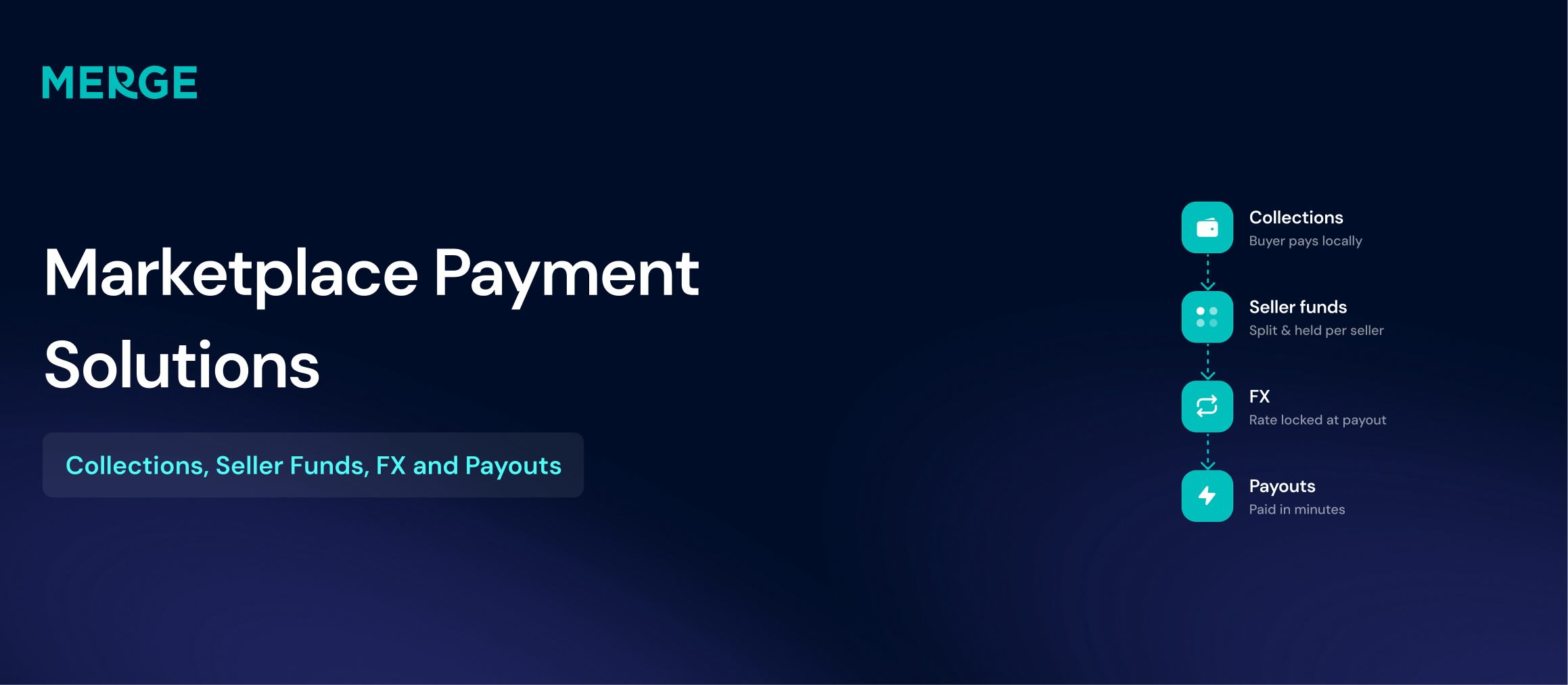


Marketplace Payment Solutions: Collections, Seller Funds, FX and Payouts
- Global marketplaces need more than card acceptance. They need one flow connecting collections, seller balances, FX, payouts and reconciliation.
- A buyer payment, marketplace fee and seller payout are separate records. Shared IDs and clear statuses link them.
- Start with one corridor and one seller-payout route. Track funding time, FX cost, payout success and reconciliation exceptions, then expand.
A global marketplace can accept a buyer’s payment and still fail to pay the right seller. The difficult part sits between those events. Platforms must identify each collection, calculate commission and seller balances, manage foreign exchange, send local payouts and reconcile every record. Marketplace payment solutions connect those steps through one clear payment flow.
That connection gives product, finance and operations teams an accurate view of where funds came from, what the platform deducted and whether the seller received the correct amount. For global operators, records, status updates and corridor coverage matter just as much as checkout.
What Are Marketplace Payment Solutions?
Marketplace payment solutions cover the full route from buyer collection to seller payout. They record who paid, which order received the money and which seller earned the balance. They then support fee calculation, currency conversion, payout and reporting.
The category can include:
- Customer collections and payment status
- Seller onboarding and payout data
- Marketplace fees and commissions
- Seller balances and payout-ready amounts
- FX quotes, conversions and charges
- Local and cross-border payouts
- Refunds, returns and failed payments
- Reconciliation, reporting and exception records
A payment gateway handles the checkout event. A marketplace payment platform manages what happens after checkout. That wider remit includes seller allocation, commissions, reserves, FX, payout status and ledger records.
That distinction helps buyers compare products. Payment processing solutions often focus on acceptance and acquiring. Payment solutions for marketplaces must connect both sides of a multi-party transaction.
How Do Global Marketplace Payments Work?
The basic route looks like this:
Buyer → local collection rail → payment record → fee and seller-balance calculation → FX or settlement route → local seller payout → reconciliation
Each stage has a distinct job:
- The buyer pays through a supported local method or currency.
- The platform receives a collection record and status.
- Its ledger assigns the order, commission, tax, refund reserve and seller amount.
- The seller balance becomes payout-ready under the platform’s rules.
- Currency conversion takes place where buyer and seller currencies differ.
- The provider sends the payout through a supported local rail.
- Payment, fee, FX and payout data return to the internal ledger.
Domestic rails vary by market. Euro instant transfers can make funds available within ten seconds under the SEPA Instant scheme, which runs around the clock. The European Central Bank explains the scheme and its coverage. One local rail does not create a complete international flow. The marketplace still needs routing, conversion, payout and data links across markets.
The Bank for International Settlements describes cost, speed, access and transparency as long-running cross-border payment frictions. A good marketplace payment solution tackles those issues at the workflow level, not only at checkout.
Collections: Let Buyers Pay Locally
Buyers expect familiar methods, clear currencies and quick payment confirmation. Marketplaces need clean references behind that experience. A collection has little operational value until the platform can map it to an order and seller.
The collection layer should capture:
- Payment method and currency
- Payer and account reference
- Order and seller identifiers
- Received, pending, failed or returned status
- Fees, refunds and chargebacks
- Timestamps and provider references
Local account details can help bank-transfer collections. Cards can serve other buyer groups. Online marketplace payment solutions often need both, plus local methods in priority countries. The right mix comes from buyer behaviour, average order value, refund risk and corridor coverage.
More methods can create more exceptions. A missing reference can leave finance teams searching across a bank portal, processor dashboard and order system. The collection design should set the record structure first. Method coverage comes next.
Seller Funds: Separate Payments from Balances
A £100 buyer payment is not a £100 seller payout. The platform can deduct commission, processing cost, tax and reserves. A refund can change the amount again.
For each order, keep these figures separate:
- Gross buyer payment
- Marketplace commission
- Payment cost
- Tax or refund reserve
- Net seller amount
- Payout-ready balance
Named or dedicated sub-accounts can give each seller, counterparty or entity a clear account mapping. Merge describes this structure on its page for payment infrastructure for marketplaces. Its API can expose amounts, timestamps, counterparties and balances. The marketplace applies its own order logic, seller terms and ledger treatment.
Fund terminology needs care. Safeguarding is a regulated protection, not a loose synonym for holding money. The UK’s Financial Conduct Authority says payment and e-money institutions must protect relevant funds under applicable rules. The precise structure turns on the marketplace’s role, the licensed provider and each jurisdiction. A platform should obtain legal advice for its model.
FX for Marketplaces: Price, Convert and Report Clearly
Foreign exchange payments raise practical questions. Which currency does the buyer use? Which currency reaches the seller? When is the rate set? Who pays the charge? What happens after a failed payout?
The payment record should show:
- Source and destination currencies
- Quoted and converted amounts
- Rate, spread and separate fee
- Time of quote and execution
- Payout route and final status
- Reversal or return treatment
These fields help finance teams compare expected and delivered amounts. They help support teams explain a payout without guessing. They give sellers a clear statement.
Merge locks the rate at the point of conversion within its on/off-ramp flow. Rate-lock duration varies by currency pair and jurisdiction. The public copy should not promise a fixed rate across time, a lowest-cost rate or support in every corridor.
Foreign exchange payments can use fiat rails at each end and a stablecoin settlement leg between them. Merge’s stablecoin orchestration connects conversion, routing, settlement and local delivery. The on-ramp and off-ramp product page explains how fiat enters and exits the flow. Recipients can still receive local currency.
Seller Payouts: Pay the Right Seller in the Right Market
The payout stage turns a ledger balance into a real transfer. It needs verified bank details, a supported route and a clear trigger. Common triggers include order completion, dispute resolution and a scheduled payment cycle.
A marketplace payment platform should record:
- Recipient account and currency
- Payout amount and provider reference
- Approval rule and trigger
- Submitted, processing, paid, failed or returned status
- Payment limit and cut-off information
- Seller notification and remittance data
Consider three routes. A UK marketplace collects GBP and pays a Brazilian seller in BRL. A European services platform collects EUR and pays a contractor in USD. A B2B marketplace pays suppliers through local bank rails. Each case needs a different currency pair and delivery route. Each still needs the same control points.
Local payout speed depends on rail availability, banking hours, provider checks and recipient details. Never treat an initiated payout as a completed one. The Merge global payouts page sets out API-driven payment initiation, local fiat delivery and payment status visibility across supported routes.
Why Does Reconciliation Matter in Marketplace Payments?
One order can produce many financial records. Each proves something different:
A completed buyer payment does not prove that a seller received funds. The marketplace must track both events and every record between them.
Shared identifiers make that chain easier to audit. An order ID can link the collection to a seller ledger. A payout ID can link the balance to the delivery status. Webhooks can update systems after status changes. Exceptions should enter a review queue with the source record attached.
Merge’s payment reconciliation product exposes incoming and outgoing records, sub-account balances and settlement confirmations through a structured data layer. Clients set their own matching and escalation logic. Merge surfaces unmatched records through its API and dashboard.
What Should a Marketplace Payment Platform Include?
Use a corridor-level test, not a feature-count contest. Check the provider against the exact buyer, seller and legal-entity route you plan to launch.
The buyer checklist should cover:
- Relevant collection methods and account details
- Seller onboarding and payout fields
- Multi-currency balances or payment records
- FX quote, conversion and fee data
- Local payout coverage and status updates
- API access, webhooks and structured errors
- Refund, return and failed-payment handling
- Reconciliation exports and exception data
- Role-based approvals and audit records
Global payment solutions can show impressive country totals. A headline number says little about a specific route. Confirm the collection currency, conversion pair, payout currency, recipient type and payment limit.
The same rule applies to digital payment solutions. Ask which legal entity provides each service. Check onboarding requirements and prohibited activities. Review safeguarding or fund-segregation terms with counsel. Test the data returned after a failure, not only after a successful payment.
How Merge Supports Global Marketplace Payment Flows
Merge provides one API layer for collections, FX, stablecoin settlement routes, local payouts and payment data across supported corridors. Its stablecoin payments API can sit inside a marketplace product and connect named accounts, conversions, transfers and status events.
Multi-currency accounts let teams collect, hold and send supported currencies without forced conversion on every receipt. Named account structures can map funds to sellers or business entities. This supports cleaner reporting and fewer manual matches.
Stablecoins serve as a settlement medium inside selected cross-border routes. They do not remove seller onboarding, fraud controls, accounting or approvals. They do not turn Merge into the marketplace’s merchant of record. The marketplace keeps responsibility for seller policies, commercial rules and duties that sit outside Merge’s regulated payment role.
The result is practical. Merge connects buyer-side collection records with seller-side payment data. Its infrastructure can replace several separate integrations for account structure, conversion, payout and reconciliation. Existing acquirer or banking relationships can remain where the marketplace needs them.
This scope matters in a market crowded with digital payments solutions and broad marketplace payments solutions claims. The useful test is simple. Can the provider show the full record chain for your chosen route?
How to Choose Payment Solutions for a Global Marketplace?
Ask these questions during procurement and technical design:
- Which buyer and seller countries are supported today?
- Which collection and payout currencies work for this route?
- Which local methods serve the target buyer group?
- Can sellers receive local currency or stablecoin by choice?
- At what point is the FX rate locked?
- How do reporting fields show rate, spread and charge?
- Can one ID link collection, balance, conversion and payout?
- What happens after a refund, failed payout or returned transfer?
- Which data arrives through API, webhook and export?
- Which licensed entity provides each part of the service?
- How are unmatched records flagged and assigned?
Payment solutions for marketplaces should be tested with real exceptions. Use an invalid account, a duplicate instruction and a returned transfer in a controlled environment. Check status names, webhook order, retry rules and ledger effects.
Start with One Market and One Seller-Payout Flow
Choose one buyer country, one seller country and one currency pair. Add one collection method, one payout route and one seller segment. That scope gives product, finance and operations teams a clean test.
Measure collection success, payout success, time to payout, FX cost, failed payments and unmatched records. Set an owner for every exception. Compare the promised data model with the records your finance team receives.
Then review the route with legal, compliance and accounting teams. Global marketplace payment solutions work best as shared infrastructure, not as a substitute for those functions.
Merge can assess the route, account structure, conversion point and payout data for your first corridor. Book a marketplace payments assessment to map the flow before integration.
FAQ
What are marketplace payment solutions?

They connect buyer collections, seller balances, FX, payouts and reconciliation. They carry the records needed to show where money came from, what the marketplace deducted and what the seller received.
How do marketplaces collect payments and pay sellers?
The buyer pays through a supported method. The platform maps that payment to an order, calculates fees and the seller amount, then triggers a payout through a supported local or cross-border route.
What is the difference between a gateway and a marketplace payment platform?
A gateway accepts a payment at checkout. The wider platform manages allocation, seller balances, currency conversion, payout status and reporting.
How do global marketplaces manage FX and seller payouts?
They define the buyer currency, seller currency, conversion point and fee treatment. The provider converts funds on a supported corridor and sends the payout through the selected local rail.
Can marketplaces pay sellers in local currency?
Yes, on supported corridors. Availability, timing, limits and rates vary by provider, currency, recipient and jurisdiction. Confirm the exact route during onboarding.
Disclaimer: This content is intended for informational purposes only. It should not be considered financial, legal, or operational advice. Businesses should evaluate their own compliance, regulatory, and infrastructure requirements before implementing payment solutions.