

Cross-Border Payment Reconciliation Software: How It Matches Fiat, Stablecoin and Payout Records
- Payment reconciliation software matches one transaction across fiat collection, conversion, stablecoin settlement, payout and internal ledger records.
- A blockchain transaction hash proves an on-chain movement. It does not prove that local currency reached the recipient or that the ledger is complete.
- A sound cross-border payment reconciliation process needs shared IDs, clear statuses, structured events and an exception queue with named owners.
Payment reconciliation software helps finance and payments teams match instructions, settlement events, fees, conversions and payouts against internal records. For cross-border payments, it must connect fiat, stablecoin and local payout data. Each transaction then has a clear status, owner and audit trail.
One customer payment can produce six or seven records. Each record can carry a different ID, amount, timestamp and status. Finance teams must prove that those records describe one completed payment, or find the break.
What Is Payment Reconciliation?
Payment reconciliation is the act of comparing payment records across systems. The aim is to confirm that the recorded amounts, currencies, fees and statuses agree.
A completed payment record should match the original instruction and the amount sent. It should capture the currency, conversion rate and fee. It should link settlement evidence to the recipient payout result. The related ledger entries must agree with those records. Any hold, return, reversal or correction needs its own entry.
This definition explains the payment reconciliation meaning in practical terms. Finance teams are not checking one bank statement. They are proving what happened to a payment from start to finish.
Financial reconciliation has a wider scope. It can cover bank balances, invoices, card settlements, journal entries and many other records. Payments reconciliation focuses on money movement and its related operational data.
Why Is Cross-Border Payment Matching Harder?
A domestic bank transfer may create only a small set of records. A cross-border payment routed through stablecoins has more legs.
The sender first creates a payment instruction. Funds arrive through a local fiat rail. A conversion changes the amount and currency. Stablecoins then move on-chain. A second conversion may take place at the destination. The recipient receives a payout through a local rail. Finance records the full flow in its ledger.
Different providers may own each leg. Their records can arrive at different times. Their identifiers may have no obvious link. One system may record local time, and another may use UTC. Fees and rounding can create valid amount differences.
Settlement confirmation is not the same as end-to-end payment completion. An on-chain transfer may show as confirmed, yet the off-ramp remains pending. The receiving bank can reject the payout later. Screening may place funds on hold. A return may arrive after the first completion message.
The Bank for International Settlements report on stablecoins in cross-border payments examines how stablecoin arrangements interact with other payment methods. It points to legal, regulatory and operational differences between jurisdictions. These differences support an end-to-end record that covers each fiat and stablecoin leg.
That gap matters. A finance team could close the ledger against the blockchain record, then miss a failed local payout. The customer sees no money, yet the internal record looks settled.
How the Payment Reconciliation Process Works
A useful process follows the transaction through seven stages.
1. Create One Payment Reference
Create an internal payment ID at initiation. Keep it unchanged across collection, conversion, settlement and payout records. This ID becomes the main link between systems.
2. Attach the Fiat Collection
Record the bank reference, amount received, currency and collection status. Link those fields to the internal payment ID. A received amount may differ from the instruction, so store both values.
3. Record the Conversion
Capture the approved FX rate, fee, source amount, destination amount and timestamp. Keep the quoted data beside the executed data. This makes valid variance easy to separate from an error.
What Records Should the System Match?
Good matching starts with a defined data model. It does not assume every bank, chain or payout provider exposes the same fields.
The integration team should agree the required fields before launch. That work prevents missing data from becoming a month-end surprise.
Matching rules need clear tolerances too. Consider a payment instruction for €25,000 and a payout of MXN 462,375. The records should state the agreed FX rate, each fee and the party paying it. A small gap may be valid rounding. A larger gap may point to a stale quote, an extra provider charge or a partial payout.
Time rules need the same care. A local rail may report a pending status long after the chain confirms settlement. The system should keep the payment open until the expected payout event arrives. It should flag the record once the agreed time limit passes.
Strong transaction matching uses exact identifiers first. It then applies amount, currency and time rules. Weak matching relies on amount alone. Two supplier payments for the same value can then be joined to the wrong records.
Keep raw source events beside normalised reconciliation payment records. The raw event preserves evidence. The normalised record gives finance teams consistent fields across providers
4. Link the Stablecoin Transfer
Store the transaction hash, wallet addresses, stablecoin, network and confirmation status. Connect that evidence to the same payment ID. The hash proves the on-chain leg, not the final payout.
5. Record the Off-Ramp and Payout
Capture the second conversion, where one occurs. Add the payout reference, recipient account, paid amount and local rail status. Pending, rejected, returned and paid are different states.
6. Match the Ledger Entries
Link the operational events to ledger references. Check principal, fees, FX treatment and any suspense entries. The software supports ledger matching. Finance retains control of accounting rules and posting policy.
7. Route Mismatches to an Exception Queue
Send unmatched records to a visible queue. Give each item a reason code, owner and next action. Record the final resolution. This is how teams reconcile payments without losing awkward cases between portals.
Transaction reconciliation works best when matching rules reflect the route. Exact ID matching should take priority. Amount and timing rules can handle known fees, FX differences and late events.
Matching Fiat, Stablecoin and Payout Records
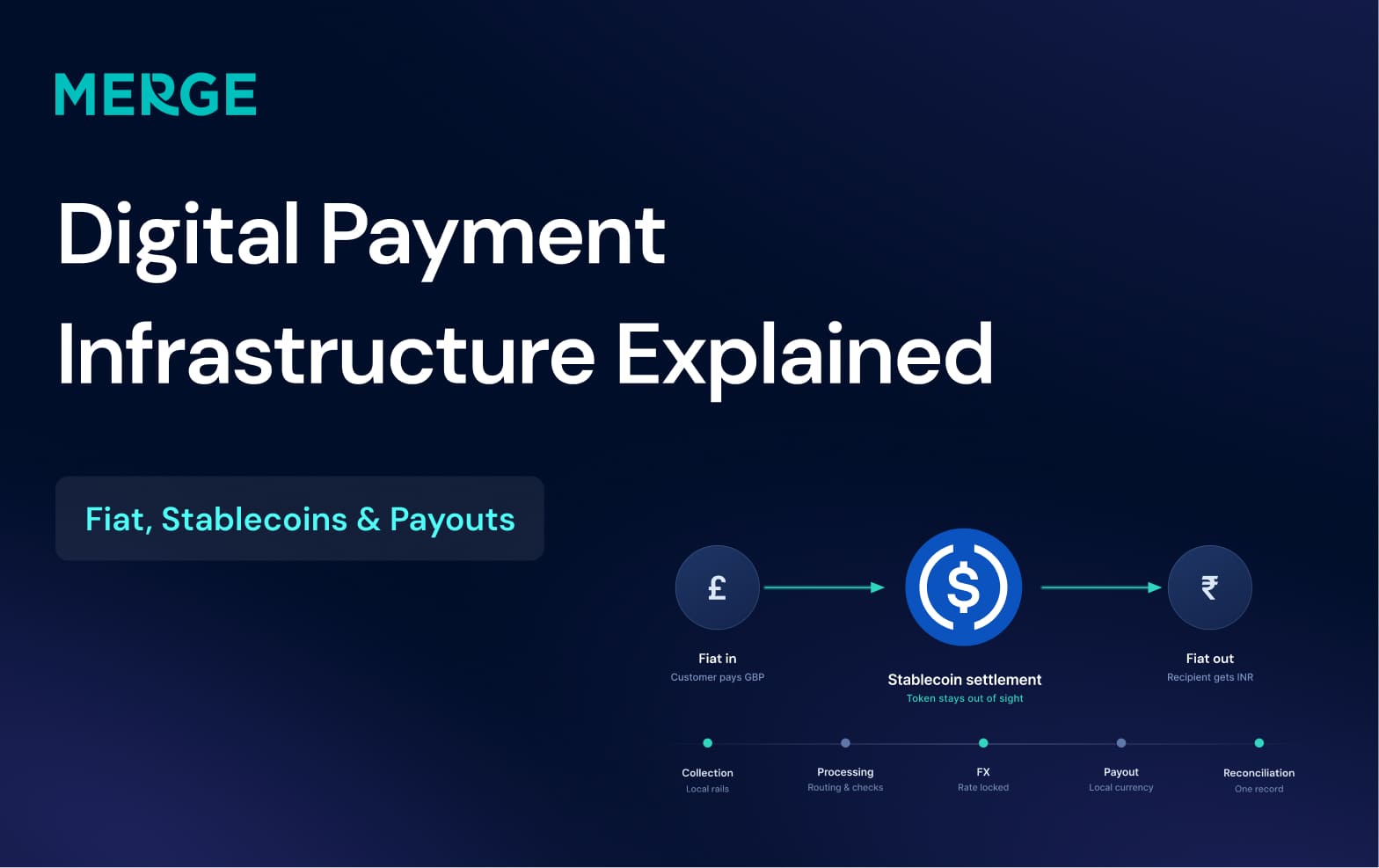
The full route runs from sender to local fiat collection. It then moves through screening, conversion and on-chain settlement. A destination conversion and local payout follow. Ledger and reporting records close the trail.
The internal payment ID should persist across every stage. Provider and payout references sit beside it. The transaction hash supplies chain evidence. Amounts and currencies show the value at each leg.
The record should retain the FX rate, conversion time and every fee. It should state who pays each fee. Payment status and exception reason must remain visible. Timestamps should use one standard, preferably UTC.
Imagine a supplier payment from pounds to Brazilian reais. The payer sends £10,000. The system records the sterling collection. It records the locked conversion rate and fee. Stablecoins carry the settlement value between the two fiat legs. The off-ramp creates the real amount. PIX handles the local payout.
The transaction hash confirms that stablecoins moved. It cannot confirm the supplier’s bank credited the real payout. The payout reference and local rail status provide that evidence. The ledger then needs separate entries for principal, FX and fees.
This example shows why stablecoin reconciliation cannot stop at a chain explorer. It must join on-chain evidence to fiat records and recipient delivery.
What Should a Reconciliation Platform Do?
A payment reconciliation system should preserve one reference across the full route. It should ingest structured API events and webhooks. It should match records by ID, amount, status and time.
It should compare expected and actual amounts. It should keep completed, pending, held, failed and returned payments separate. It should flag exceptions and retain supporting evidence.
Finance, operations and audit teams need usable exports. The platform should support existing accounting and ERP workflows. It should not replace accounting judgement.
Real-time matching depends on the arrival of source events. A fast on-chain confirmation does not make a delayed bank callback appear sooner. Good software shows that timing gap instead of hiding it.
How Merge Supports Financial Reconciliation
Merge’s matching product exposes incoming and outgoing payment records, sub-account balances and blockchain settlement confirmations in one structured data layer. Clients can run matching from event triggers, scheduled jobs or an on-demand request.
Named sub-accounts give each entity, counterparty or cost centre a clear map. That structure helps clients reconcile payment activity at source. Unmatched payments appear through the API and dashboard. Clients then set review, alert and escalation rules.
The Merge stablecoin payments API connects local fiat rails, conversion, stablecoin settlement and payouts through one integration. Webhooks and API status endpoints provide payment lifecycle updates.
For fiat-to-stablecoin and stablecoin-to-fiat routes, Merge’s on-ramp and off-ramp infrastructure links local collection and payout rails with conversion and settlement data. This gives payment teams a connected record across the route.
Merge provides the data and controls that support automated financial reconciliation. The customer sets its own matching logic, accounting rules, approvals and reconciliation policy. Merge does not complete the customer’s accounting work.
This boundary matters. A provider can supply clean records and exception hooks. Only the customer can decide how a fee, timing difference or returned payout should appear in its ledger.
Questions to Ask Before Choosing Matching Software
Buyers should test the payment flow, not only the feature list.
- Can the system link payment IDs, provider references, payout IDs and transaction hashes?
- Does it show on-chain confirmation and local payout status as separate events?
- Can it match several currencies, rates, fees and valid rounding differences?
- How does it handle failed, returned and screened payments?
- Which data arrives through API, webhook, file or dashboard export?
- Can finance export evidence for audit and ledger posting?
- Who owns unmatched payment records?
- Can the system report by corridor, entity and counterparty?
Ask vendors to demonstrate one failed payment. A perfect happy path reveals little about operational control. The failed case shows whether statuses, ownership and evidence remain clear.
Start with One Corridor and One Rule Set
Begin with one route, such as GBP collection and BRL payout. Map each record and owner. Define the allowed fee, FX and timing differences. Set rules for pending, failed, held and returned payments.
Then measure six points:
- Time from payment initiation to ledger match
- Share of payments matched automatically
- Number of exceptions
- Average exception resolution time
- Fee and FX variance
- Failed or returned payouts
These measures expose weak data links and slow hand-offs. They give the team a factual baseline for the next corridor. Comparing payment reconciliations across weeks will show whether changes reduce manual work.
Merge supports cross-border business payments across local rails and stablecoin settlement. Teams can assess one corridor, its data model and its reconciliation workflow before wider rollout.
Book an assessment to map the route, records, matching rules and exception owners.
FAQ
What is the difference between payment settlement and payment reconciliation?

Settlement moves value between parties or providers. Reconciliation checks that every related record agrees. A settled on-chain transfer can still have a pending or failed local payout.
How does payment reconciliation software work?
The software ingests payment data from APIs, webhooks, files or exports. It matches records using IDs, amounts, currencies, status and time. Unmatched items move to an exception queue.
Can stablecoin payments be reconciled with fiat payments?
Yes. The data model must link fiat collection, conversion, transaction hash, off-ramp and payout records. A shared internal payment ID gives each leg a common reference.
What happens if a payout fails after stablecoin settlement?
The on-chain leg stays recorded as confirmed. The payout record changes to failed or returned. The item moves to an exception queue for review, correction and ledger treatment.
What data should a cross-border payment reconciliation system retain?
Keep internal and provider IDs, transaction hashes, amounts, currencies, FX rates, fees, statuses, timestamps and exception details. Retain payout evidence, ledger references, ownership and resolution history too.
Disclaimer: This content is intended for informational purposes only. It should not be considered financial, legal, or operational advice. Businesses should evaluate their own compliance, regulatory, and infrastructure requirements before implementing payment solutions.