Use Cases
Send International Business Payments
Cross-border B2B payments via local rails and stablecoin settlement, built for supplier payments, contractor payouts, and treasury transfers.
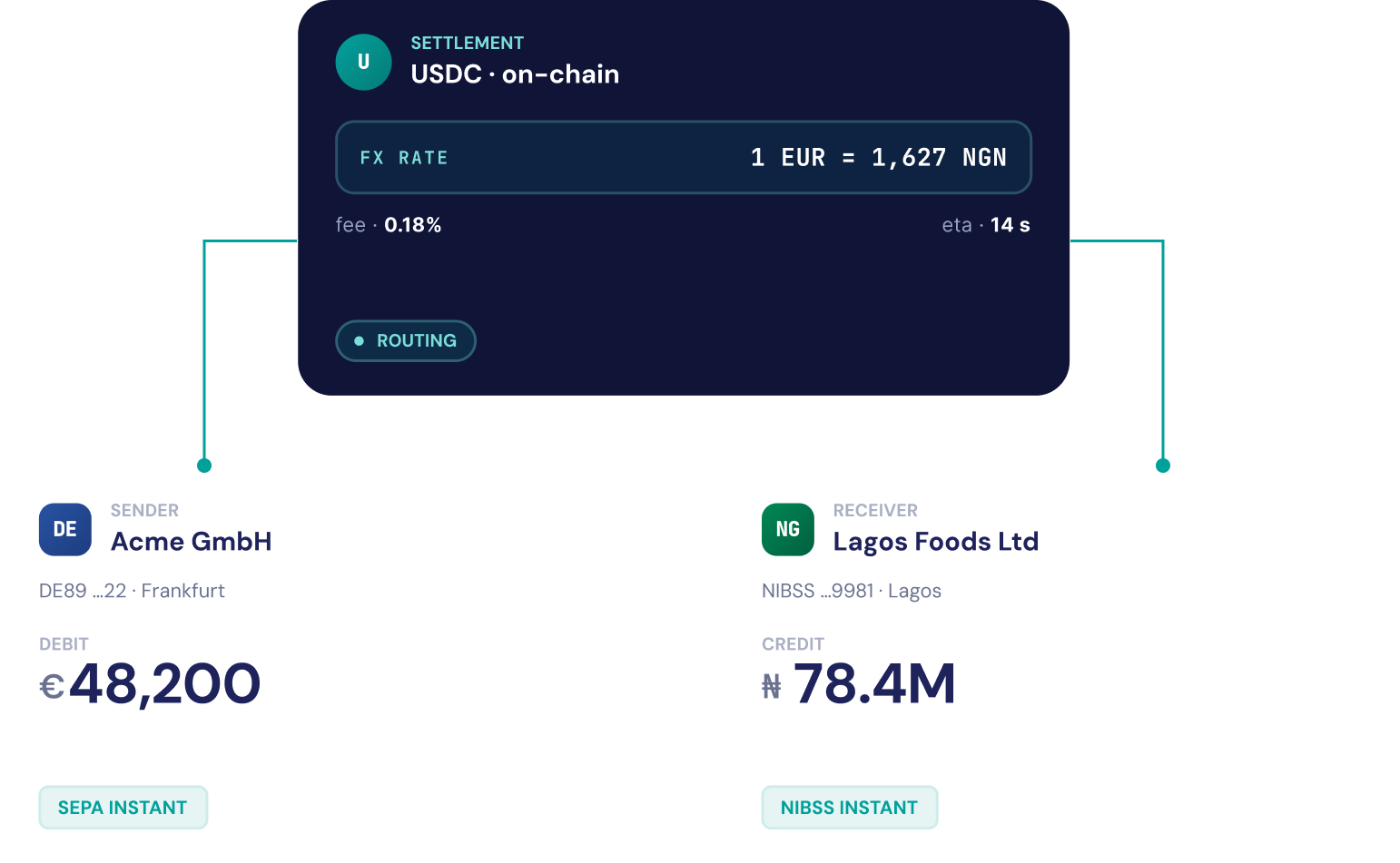


Merge is built for businesses that send frequent, high‑value, recurring cross‑border payments. This is not for one‑off consumer transfers. It is for:


Merge connects local fiat rails, stablecoin settlement infrastructure, and named accounts so finance teams get more control and less operational friction.
Business money transfer should be reliable, predictable, and easy to operate at scale. Merge supports business money transfers across suppliers, vendors, and contractors in different markets. You can send funds in the currency you hold and pay recipients in the currency they need.

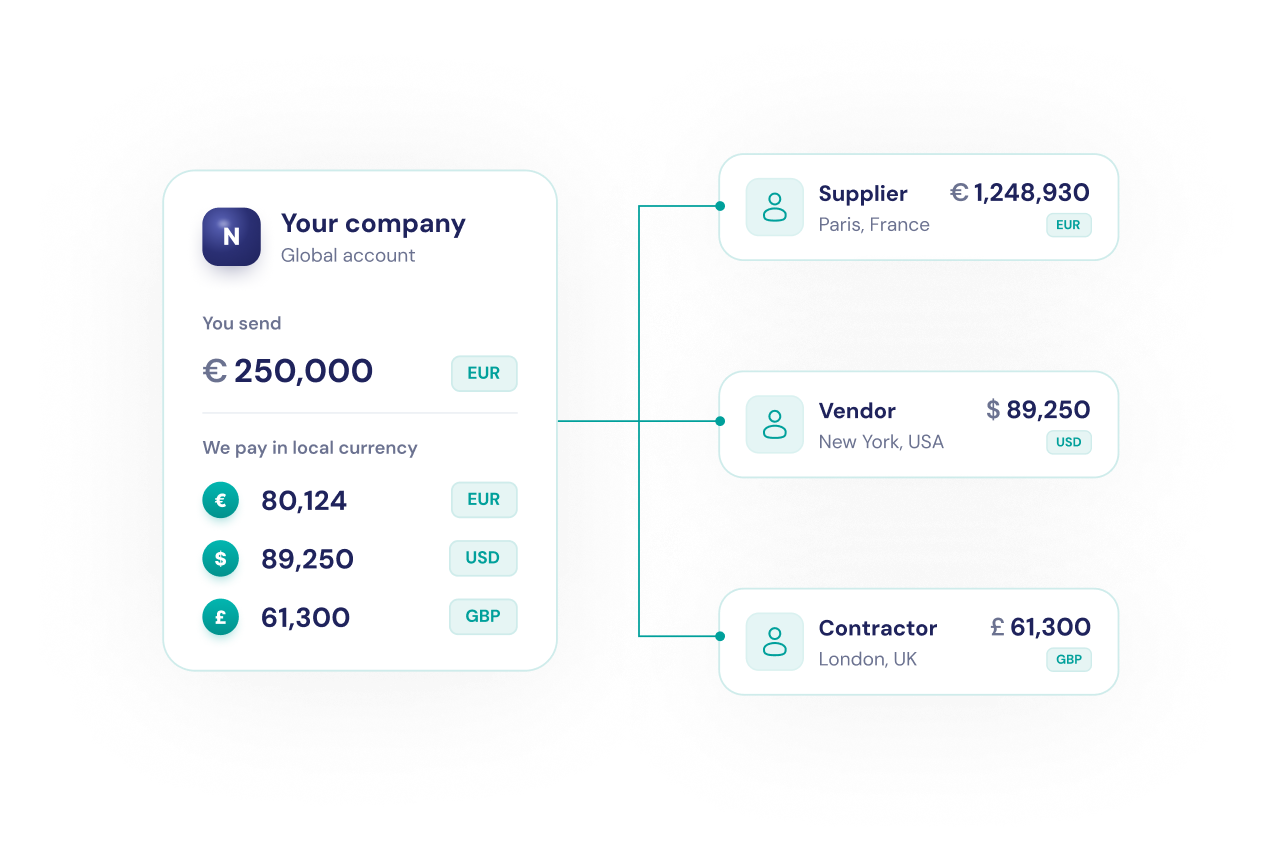

Finance teams track amounts by counterparty across all payment flows

Control FX with locked rates before funds move, with no mid-chain surprises

Clear visibility into payment status at every stage of the lifecycle
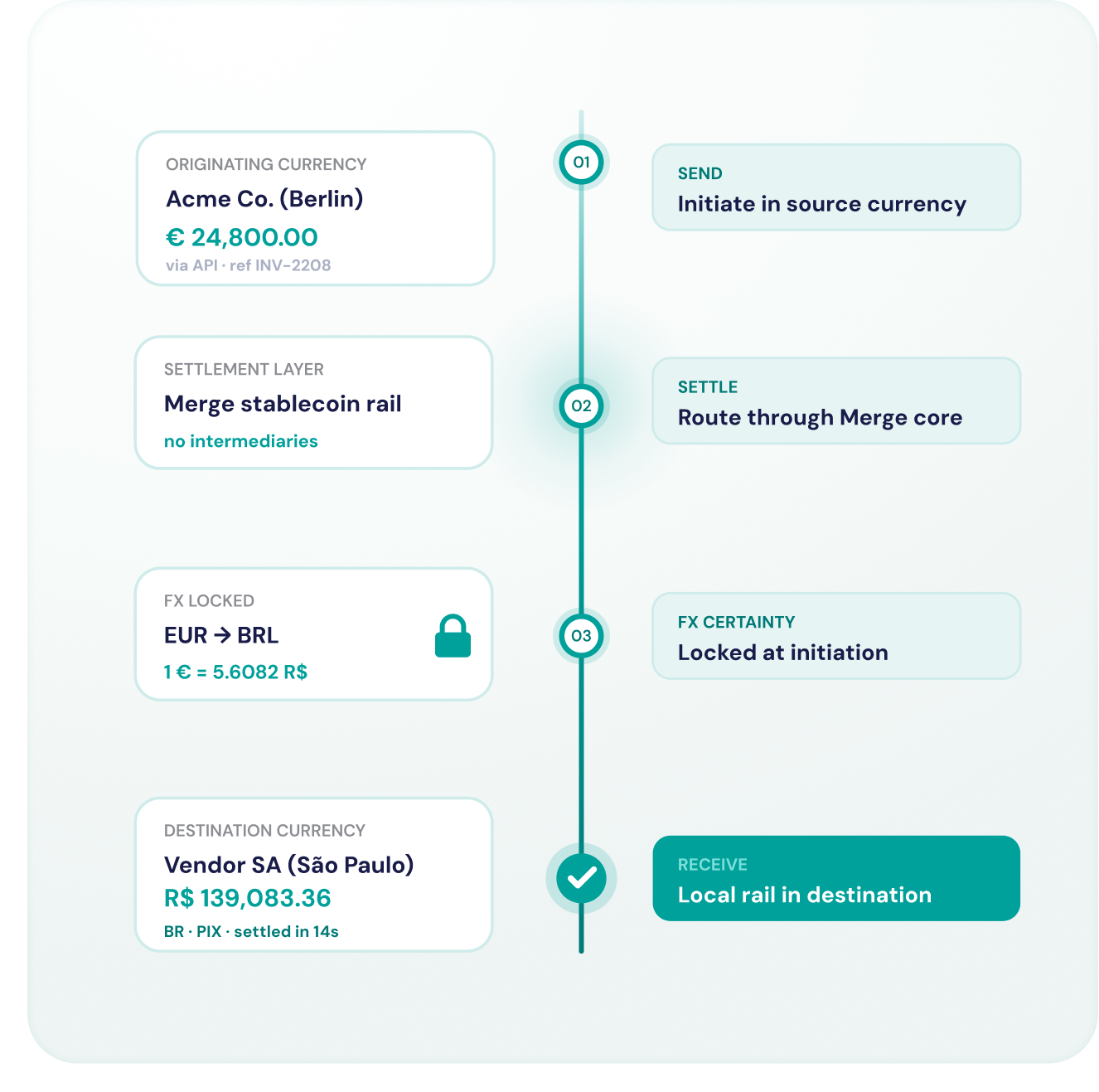
Merge follows a simple four‑step flow for every international business payment:
Talk to the Merge team and we'll configure the payment infrastructure that fits your use case.
For business FX transfers, clarity matters. Finance teams need to know what will be sent, what will arrive, and which rate applies before the payment is released with Merge:
| Feature | Outcome |
|---|---|
|
Rate locked at initiation
|
See the exchange rate before funds move, no hidden markups
|
|
Total amount confirmed upfront
|
Know the full cost before payment is released
|
|
Real-time status tracking
|
Track progress across settlement, FX, and payout
|
|
Counterparty-level tracking
|
Track amounts by counterparty with controlled FX
|
|
Lower reconciliation burden
|
Reduce manual work with predictable workflows
|
Merge supports international business account infrastructure with sub-accounts, IBANs, and virtual account numbers mapped to entities, counterparties, or business lines, keeping funds separated and reconciliation simple. This is payment infrastructure, not a bank account.
Finance teams can connect these accounts with multi-currency accounts and stablecoin on/off ramp infrastructure, managing funds and settlement across markets from one platform.

Companies often start with basic transfers. As operations grow, they need more control over currencies, reconciliation, counterparties, and payout timing. Merge scales with your operation across:


Many international payment providers solve only part of the problem: one for accounts, another for FX, a third for payouts and reporting. This creates hand-offs, delays, and reconciliation gaps. Merge brings the full stack together:
| Feature | Outcome |
|---|---|
|
Local fiat rails
|
Cost-efficient payouts in local currency
|
|
Stablecoin settlement infrastructure
|
Faster settlement between originating and destination legs
|
|
FX execution with locked rate at initiation
|
Cost certainty before funds move
|
|
Named accounts and sub-accounts
|
Clear fund separation and counterparty tracking
|
|
API control and automation
|
Programmable, repeatable payment workflows
|
|
Compliance workflows
|
Built into the payment lifecycle
|
|
Payment reconciliation and reporting
|
Unified visibility in one place
|


Move beyond fragmented workflows and limited visibility. Merge gives you the infrastructure to send international business payments with clearer FX, faster settlement, and full control across every stage.

International business payments are cross‑border payments sent between companies, suppliers, contractors, sellers, or business entities in different jurisdictions. With Merge, funds can be sent in the originating currency, routed through stablecoin settlement infrastructure, and received in the destination currency through local payment rails, giving businesses clearer visibility across FX, settlement, and payout status.
The best business account for international payments should support the currencies, countries, counterparties, reporting needs, and payment volumes your company manages. Merge is not positioned as a bank account provider; it offers payment infrastructure that can support named accounts, local rail access, FX execution at initiation, stablecoin settlement, and payout workflows for business payment operations.
Lock the FX rate at initiation, use named accounts mapped to specific counterparties, and track payment status in real time across every stage. Fewer intermediaries means fewer points of failure, so avoid correspondent banking chains where possible. Structured payment data and clear reconciliation controls reduce the risk of misdirection on high-value transfers.
Merge can support account infrastructure for receiving international payments through named sub‑accounts, IBANs, and virtual account numbers where available. These accounts can map to entities, counterparties, or business lines, helping companies track incoming funds and connect them to downstream payout, settlement, and reconciliation workflows.
Merge supports money transfer business workflows by connecting local fiat rails, FX execution, stablecoin settlement infrastructure, and local currency payouts. This makes it suitable for structured B2B flows such as supplier payments, vendor payments, contractor disbursements, marketplace seller payouts, treasury transfers, and settlements between business entities.


