Use Cases
Treasury Management Solutions for Global Operations
Global treasury operations from one place. Sub-accounts by entity, real-time balances, programmable fund movement, alongside your existing banking relationships.
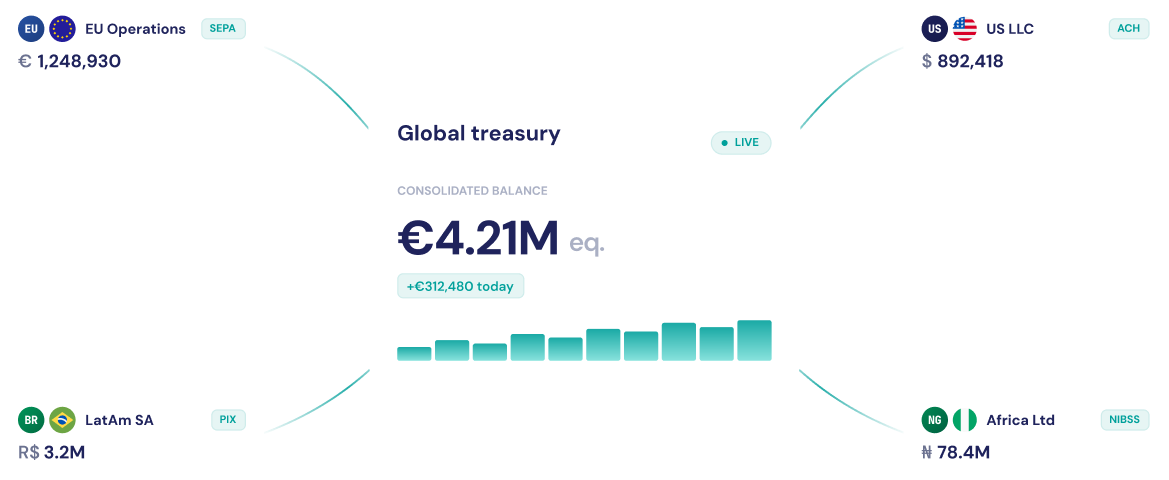


Enterprise treasury management is the operational process of moving, holding, and monitoring company funds across jurisdictions, currencies, entities, and business lines. CFOs, treasury teams, fintech operators, and financial institutions need infrastructure that supports routine payment flows, not hedging or yield optimisation.
Merge’s treasury management solutions are designed for operations, giving finance leaders visibility, segregation, and control across countries without juggling bank portals or reconciling fragmented data.
Traditional global treasury management relies on multiple regional banks and correspondent networks. Each corridor requires its own accounts and partners, leading to capital tied up across markets. Differences in cut‑off times and processing cycles increase the complexity.

Cross-border payments pass through multiple intermediaries, each adding fees and delays. Merge helps reduce these handoffs by connecting directly to local rails and stablecoin networks.

Banks hold capital in multiple nostro accounts to meet settlement windows, tying up cash. Merge’s programmable flows and stablecoin settlement help reduce idle balances.

Operating hours and public holidays trap funds in regional accounts. Merge’s always‑on settlement and stablecoin rails keep money moving 24/7.

Traditional correspondent banking offers little visibility into where funds are while in transit. Merge’s dashboard shows balances and transfers in real time.

Reconciling payments across different portals and formats is time‑consuming. Merge unifies data through a single API.
Talk to the Merge team and we'll configure the payment infrastructure that fits your use case.
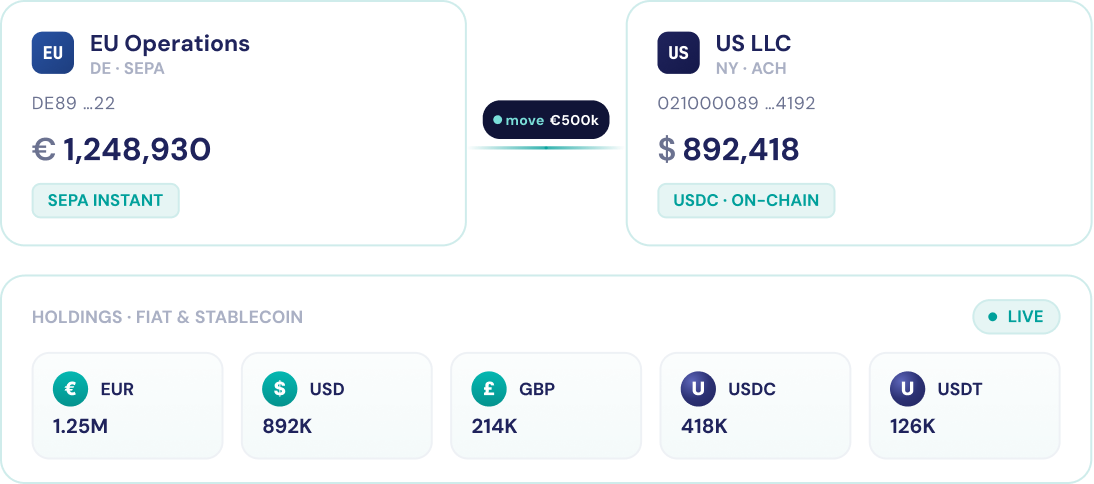
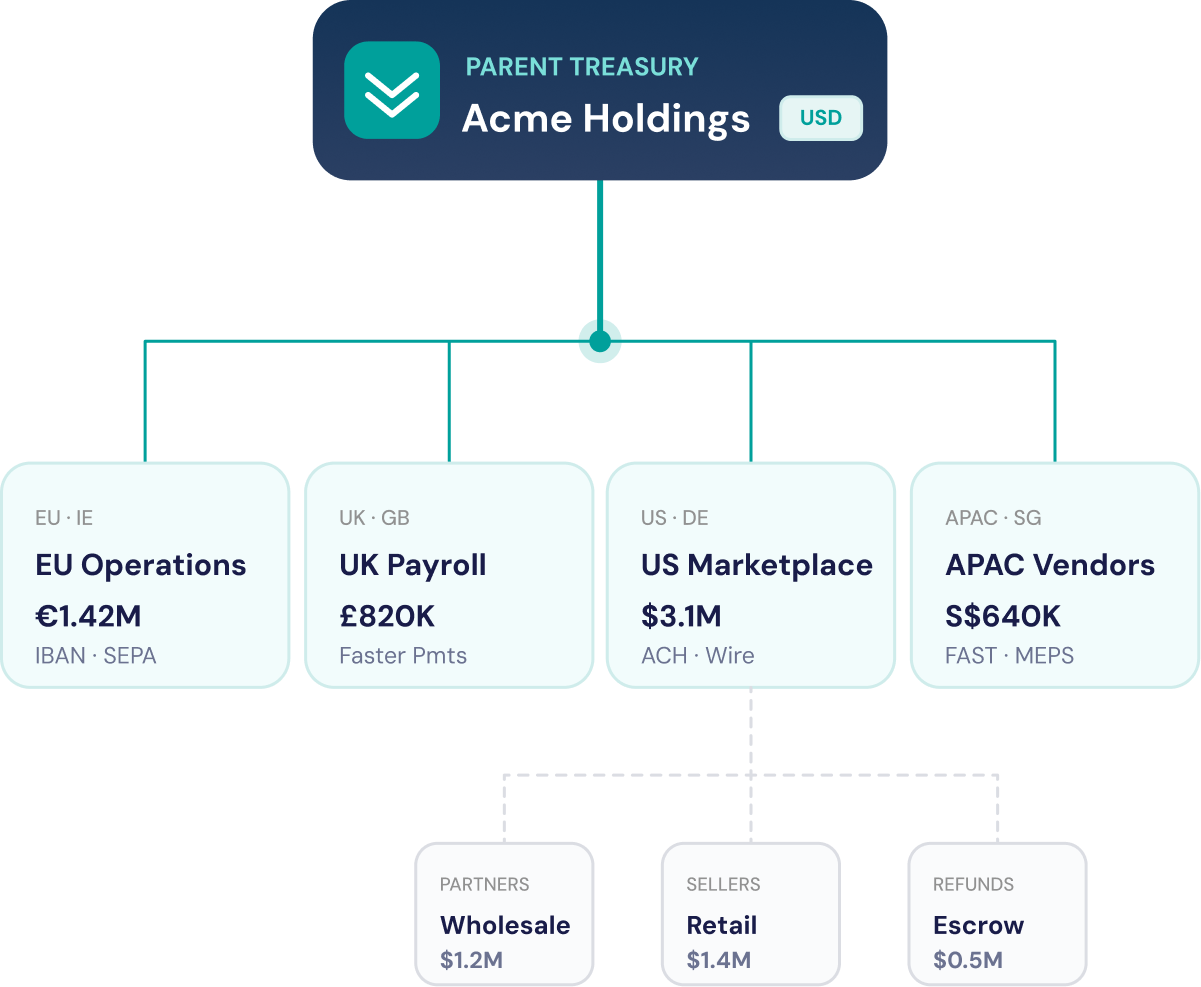
Named accounts are at the core of Merge's treasury infrastructure. Each carries its own identifier and local rail access, so funds stay segregated by entity, region, business line, or counterparty, with full visibility and reconciliation in one platform.
Merge supports treasury and liquidity management through programmable fund movement rules and triggers that move money based on operational needs:
Trapped cash is a common problem in traditional treasury management. Businesses hold large pre-funded balances to cover settlement delays, leaving capital idle across countries. Merge's stablecoin settlement enables just-in-time payments, freeing up that capital and helping finance teams deploy working capital more efficiently.


Finance teams often lack a single view of global balances. Merge aggregates balances across sub-accounts, currencies, and regions, giving teams clear visibility by account, entity, or region to monitor exposure and plan funding. Export data or connect via API to your ERP or cash forecasting tool. Stablecoins are optional; fiat accounts are fully supported.
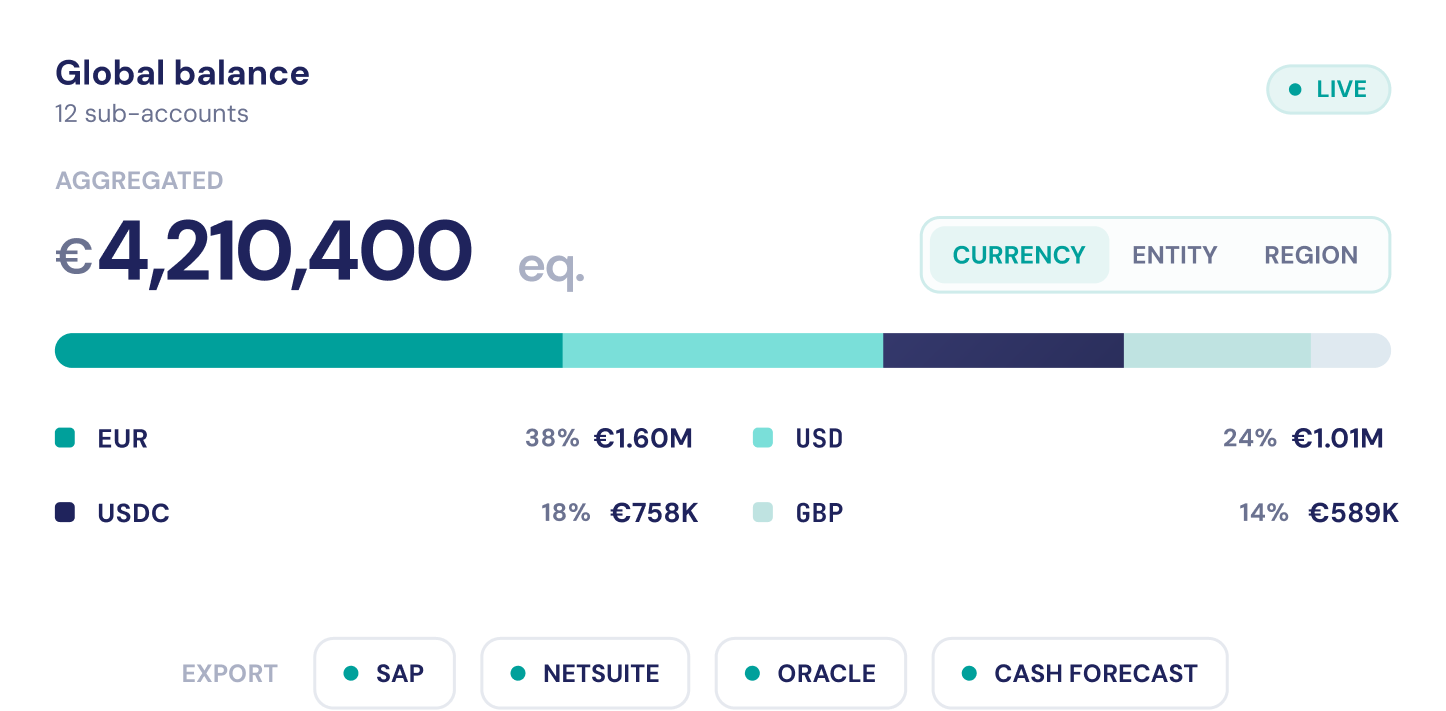


Move, hold, and monitor funds across entities, currencies, and regions through one infrastructure layer. Get clear visibility, structured sub-accounts, and flexible fund movement that fits your operational workflows.

Treasury management refers to the process of managing a company’s operational funds, liquidity, payment flows and financial visibility. In Merge’s context, treasury management means helping businesses move, hold and monitor funds across jurisdictions, currencies and entities through named sub‑accounts, local rails, stablecoin settlement, API workflows and dashboard visibility.
Enterprise treasury management is treasury operations for companies that manage funds across multiple regions, entities, currencies and counterparties. Merge supports this by giving teams structured sub‑accounts, cross‑jurisdiction fund movement, balance visibility, programmable treasury flows and settlement infrastructure designed for recurring business payment operations.
Merge is designed to complement existing banking infrastructure. Many clients continue to work with bank partners, while using Merge as the cross-border and stablecoin layer to coordinate fund movement across jurisdictions.
Merge supports treasury and liquidity management by helping teams hold funds in named sub‑accounts, map balances to entities or regions and move money through programmable rules. Fund movement can be triggered manually, on a schedule, above balance thresholds or by payment events.
Merge can help reduce trapped cash by giving treasury teams better visibility and more control over when operational funds move across jurisdictions. Instead of holding large regional balances to cover settlement delays, teams can use stablecoin‑enabled settlement and programmable treasury flows to support more just‑in‑time movement. This frees up capital that would otherwise sit idle.


