

Benefits of Stablecoins for Corporate Payments
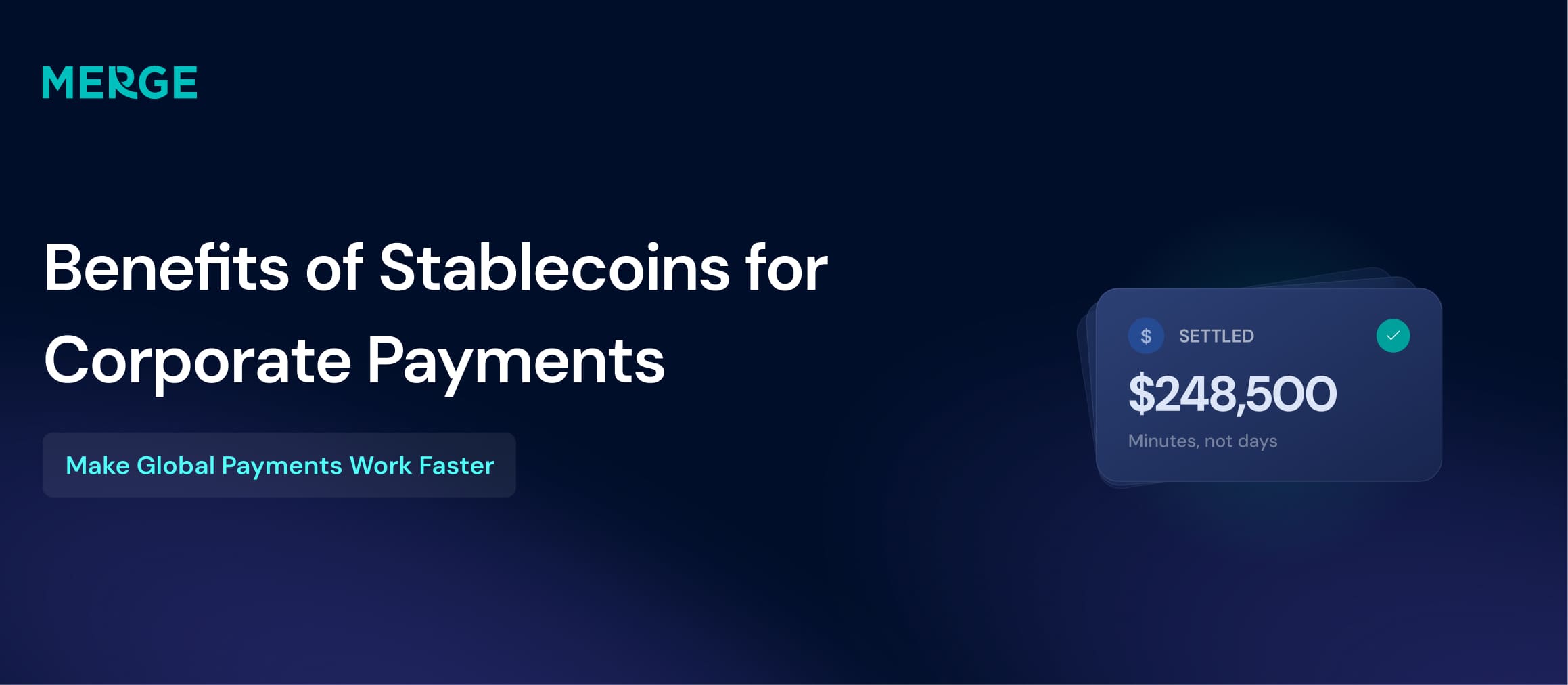
- Stablecoins can shorten the settlement leg of selected cross-border flows. They can give corporate treasury teams more continuous access to liquidity and clearer payment records.
- The model works best as fiat in, stablecoin in the middle and fiat out. Banks, FX, local payout rails and compliance checks still matter.
- Start with one corridor and one measurable problem. Track delivery time, total cost, payment exceptions, idle cash and reconciliation work.
Corporate payment teams rarely want a digital token for its own sake. They want firmer control over money moving between countries, entities and counterparties. Cross-border payments expose the delays created by separate bank accounts, cut-off times and scattered data.
The main benefits of stablecoins for corporate payments are faster settlement in selected flows, better traceability, more flexible liquidity movement, programmable workflows and simpler reconciliation. Results vary by corridor, stablecoin, liquidity provider, FX route, local payout rail and control design.
Used as settlement infrastructure, stablecoins can connect local collection with local payout. A company can still fund and receive payments in familiar currency. The token only moves inside the payment chain. That structure makes stablecoin payments relevant to finance teams, not just digital asset firms.
What Practical Gains Can Stablecoin Rails Offer?
- Faster settlement in selected flows. On-chain transfers can shorten the middle leg of a cross-border payment.
- More continuous liquidity movement. Treasury teams can move value outside many correspondent-bank operating windows.
- Better traceability. Payment status and on-chain references can support finance operations and investigations.
- Programmable workflows. APIs can connect conversion, approval, payout, status and reconciliation events.
- Less fragmented infrastructure. One layer can link local fiat collection, stablecoin settlement and local fiat payout.
- Simpler reconciliation. Structured records can reduce manual matching across banks and payment providers.
These are possible operational gains, not promises for every transfer. Total cost, speed and access rely on corridor coverage, compliance review, FX, liquidity, local rails and exception handling. The benefits of using stablecoins for payments come from the complete operating model, not the blockchain transfer alone.
How Stablecoin Payments Work for Companies
A common stablecoin payments model places the token between two fiat payment legs:
The business funds the payment in local currency. The provider checks the company, payment and recipient. It converts the funds into a suitable stablecoin, such as USDC or USDT. The token crosses the chosen network. The provider then converts it into the destination currency and sends it over a local rail.
The payer or recipient does not need to manage a wallet in this model. Neither side needs to hold a stablecoin on its balance sheet for a long period. Merge describes its stablecoin payments API as local currency in, on-chain settlement in the middle and local currency out.
This structure gives a corporate payments solution access to blockchain settlement without making the user experience feel like a crypto product. It does not remove every intermediary. The provider still needs banking partners, conversion routes, local rails and compliance controls.
Stablecoins and Faster Cross-Border Settlement
Yes, for the settlement leg in suitable corridors. Stablecoin payments can run outside correspondent banking hours. For cross-border payments, an on-chain transfer can send value directly between two conversion points. That can remove several hand-offs and reduce waiting time.
End-to-end delivery covers much more than the blockchain transfer. It includes onboarding, sanctions screening, funding, conversion, local payout and any payment investigation. Recipient access to local currency can take longer than the token transfer. A clean claim is simple: stablecoin rails can reduce delay in part of selected cross-border payments.
Take a UK company paying a supplier in another market. The company funds the payment in pounds. The provider converts the funds and uses a stablecoin for cross-border settlement. A local partner then pays the supplier in the agreed currency. The finance team receives status data across each stage.
This route can be useful where domestic instant systems do not connect to one another. It should not be compared with a domestic instant rail that serves a different job. Treasury teams should measure the full payment journey, from approved instruction to usable funds. They should record exceptions too. A fast successful transfer means little if failed payments need days of manual work.
Stablecoins and Treasury Liquidity
For corporate treasury teams, regional cash buffers can become a costly habit. Those balances cover cut-off times, settlement delays and uncertain demand. The cash stays local, even where another entity needs it more.
Stablecoin settlement can support more frequent movement between legal entities and currencies. A treasury team can fund a regional account closer to the payment time. It can rebalance balances after local banking hours where the corridor and controls permit. Named sub-accounts can map funds to a legal entity, geography or business line.
Merge’s corporate treasury infrastructure supports manual transfers, scheduled funding, threshold-based sweeps and payment-event triggers. It sits beside existing banking relationships. This distinction matters. Stablecoins can reduce the operational need for some pre-positioned funds, but they do not remove funding needs, FX exposure or liquidity risk.
Treasury Team Checklist
- Legal ownership of the funds at each stage
- Currency exposure before and after conversion
- Stablecoin redemption timing
- Liquidity provider and conversion route
- User, entity and corridor limits
- Steps for market, network or partner disruption
- Reconciliation for every balance and transfer
The operational case grows clearer through this test. The question is not whether cash moves at any hour. The question is whether the team can move it with clear ownership, pricing, controls and records.
Payment Visibility and Reconciliation
Finance teams often collect records from bank statements, PSP portals, FX providers, local payout partners, ERPs and payroll or marketplace systems. Each source uses different identifiers and update times. Manual matching follows.
Stablecoin payment infrastructure can create one record across initiation, conversion, transfer, payout and confirmation. A blockchain transaction ID is only one field. The record needs an invoice, beneficiary, entity, payment purpose and internal ledger reference.
Merge provides payment status and reconciliation data through its API, webhooks and dashboard. Named sub-accounts can separate funds by entity, counterparty or cost centre. Clients then set their own reconciliation rules on top of that structure. Clients can use that structured data to trigger alerts or route unmatched payments into a finance-operations review queue.
That model can improve digital corporate payments and corporate banking payments. It can support invoice matching, reference fields, audit trails, reversals and investigations. It does not mean every exception resolves itself. The provider supplies data and control points. The finance team keeps ownership of rules, reviews and ledger treatment.
Good reconciliation measures both speed and accuracy. Track unmatched items, time to resolution, missing references and manual touches per payment. Those measures show whether new rails reduce work or simply move it elsewhere.
API-led Payment Workflows
A cross-border payments API for corporate treasury can connect payment instructions with finance controls. Teams can use it for supplier payments, contractor payroll, seller payouts, cross-entity funding and brokerage withdrawals. The same layer can send status events into an ERP or treasury system.
The value is not the movement of a token. It is one programmable control layer across accounts, conversion, payment status and reconciliation. This can turn a digital payment event into a recorded finance event.
For example, an approved invoice can trigger a payment instruction. The API can return a locked FX rate at the point of conversion. Webhooks can report each status change. A confirmed payout can send a reconciliation event to the ERP. An exception can route to a review queue.
Automation still needs boundaries. Use maker-checker permissions, approval limits, counterparty allowlists and full audit logs. Keep people responsible for policy and exceptions. Merge provides payment visibility through its API, webhooks and dashboard. Each client keeps ownership of its finance process.
A stablecoin-based corporate payments solution must connect payment movement to the work around it. That includes approval, records, review and reporting.
Broader Corporate Payment Reach
Expansion often brings a choice. Cross-border payments can require local bank accounts, PSPs, FX providers and market-by-market payout links. A unified layer can reduce that integration work.
Coverage still needs corridor-level review. Buyers should ask:
- Which countries and currencies are live today?
- Can the recipient receive local fiat, stablecoins or either?
- Which rail handles the final payout?
- What cut-off times and exception routes apply?
- Which regulated entity provides each account, conversion and payment service?
- Which transaction and settlement limits apply?
These questions matter for the benefits of stablecoins for financial institutions too. Banks and payment firms already carry regulatory duties. They need clear roles, records and service boundaries. A broad network claim has little value where a priority corridor lacks local liquidity or a reliable off-ramp.
Benefits Paired with Trade-Offs
Risks for Businesses
Finance, legal and operations teams need to assess these risks before live payments begin.
Compliance and Sanctions
Stablecoin payments do not weaken sanctions duties. OFAC FAQ 560 states that US sanctions obligations apply to digital currency and fiat currency alike. Companies need risk-based screening, transaction monitoring, KYB ownership and clear escalation routes. Local rules can add licensing, reporting or capital-control requirements.
Issuer and Redemption Risk
Ask which stablecoin the route uses and who issues it. Review reserve disclosures, redemption rights, banking partners and past periods of price stress. Set a plan for delayed or restricted redemption. A stable price target is not a guarantee.
Liquidity and FX Risk
A stablecoin can remove one settlement delay and add conversion work. Spreads, market depth and timing can change the final cost. Large payments can face thinner liquidity in some corridors. Set FX approval rules and price limits before launch.
Operational Risk
Wallet addresses can be wrong. Transfers can be irreversible. Networks and providers can fail. Fraudsters can alter beneficiary details through social engineering. Use address validation, allowlists, dual approval, transaction limits and tested incident steps. Record how the team will handle stuck, reversed or unmatched payments.
Legal and Accounting Treatment
Fund ownership, safeguarding, tax and balance-sheet treatment differ across jurisdictions and business models. Take legal, tax and accounting advice for each planned flow. Write the chosen treatment into internal policy and test it with auditors.
Provider Concentration
One platform can replace several connections, but that creates dependency. Review fallback rails, data export, service recovery and access to funds during an outage. The benefits of using stablecoins for payments are strongest where controls cover failure, not just success.
A Framework for Corporate Stablecoin Adoption
Start with one corridor and a defined pain point. Do not start with a token choice. Payment processing solutions for corporate stablecoin adoption should fit the operating model, control structure and recipient experience.
Set acceptance criteria before funds move. Give the pilot a named owner in treasury, finance operations, compliance and engineering. Agree the maximum value, approved beneficiaries, test hours and stop conditions. Run normal cases and failure cases, including a rejected beneficiary, delayed payout, bad reference and unavailable route. Capture evidence for each approval and status change. A controlled pilot should answer a business question, not just prove the API can send money.
Teams researching how to integrate a cross-border payments API for corporate treasury should test real operations. Use representative payment values and beneficiary types. Record total cost, delivery time, exceptions, manual work and cash held in advance.
Compare payment processing platforms for corporate stablecoin adoption on the same corridor data. Marketing claims cannot replace a pilot. Set a baseline from existing corporate banking payments, then compare the new route against it. Keep digital corporate payments in fiat at each end where that gives users a clearer experience.
The Practical Next Step
The benefits of stablecoins for corporate payments are strongest where a business treats the token as infrastructure, not speculation. Pick one measurable corridor. Define ownership, approvals, limits and fallback routes. Keep customers and suppliers in familiar fiat experiences where that suits the payment. Then measure timing, cost, liquidity, visibility and reconciliation against the current route.
Talk to Merge about a corporate payment or treasury workflow. Explore its stablecoin payments API or treasury management infrastructure for the technical model.
FAQ
Are stablecoin payments faster than bank transfers?

Stablecoin payments can shorten the cross-border settlement leg. Final delivery still relies on checks, conversion, local payout rails and any payment exceptions.
Does a business need to hold stablecoins directly?
No. In a fiat-in, stablecoin-middle, fiat-out flow, the business can fund and receive payments in local currency. The stablecoin acts as the settlement layer.
Can stablecoins reduce trapped cash?
They can support more frequent movement of funds between entities and regions. Treasury teams still need funding rules, FX controls, liquidity planning and account reconciliation.
What risks do stablecoin payments create?
Key risks include sanctions exposure, issuer and redemption risk, FX and liquidity costs, wrong wallet addresses, provider outages and accounting treatment. Each payment flow needs clear controls and named owners.
How should a company start using stablecoins for corporate payments?
Start with one supported corridor and a measurable issue, such as payment delay or manual reconciliation. Set approval limits, test exception handling and compare the results with the current payment route.
Disclaimer: This content is intended for informational purposes only. It should not be considered financial, legal, or operational advice. Businesses should evaluate their own compliance, regulatory, and infrastructure requirements before implementing payment solutions.


Ready to see what Merge can do for you?
Related Articles