Cross-Border Payment Trends in 2026: What Is Actually Changing for Your Business
- Real-time delivery is becoming the baseline. A fast network is not enough if the final bank, compliance check or currency conversion still adds hours.
- Stablecoins now sit inside regulated business payment flows. Their strongest use lies in settlement, not speculation.
- Finance teams are replacing long correspondent chains and scattered bank accounts with local rails, named accounts and API-led payment infrastructure.
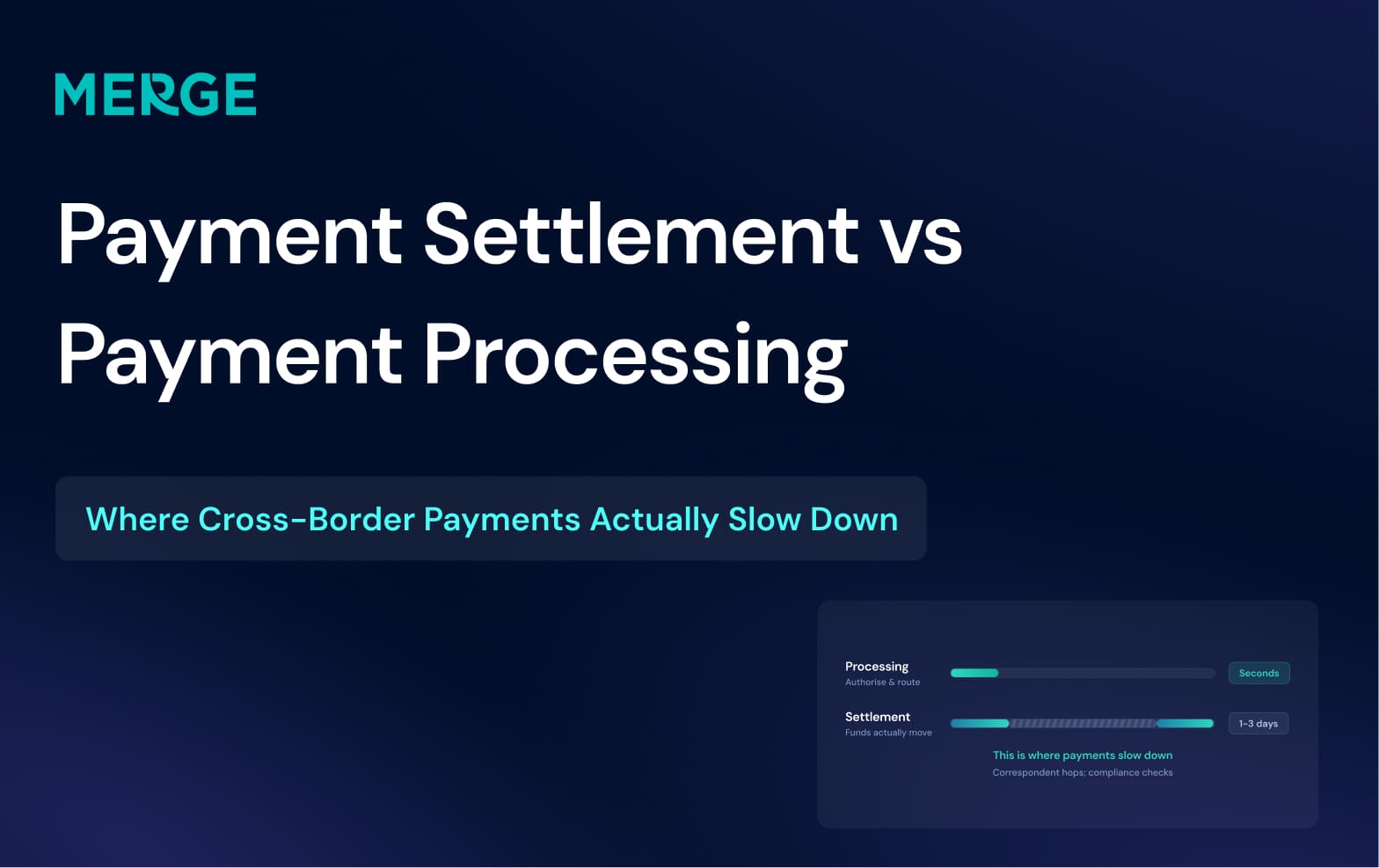
Cross-border payments entered 2026 with an unusual split. The networks have become much faster, but the full payment journey still contains old delays. SWIFT reports that 75% of payments now reach the beneficiary bank within ten minutes. That figure measures the bank-to-bank journey, not the point at which the recipient can use the funds.
That gap defines the payment trends 2026 will be judged by. Speed must reach the beneficiary. Fees must be clear before initiation. Compliance checks must catch real risk without trapping normal payments.
For founders, CFOs and treasury teams, the issue is not one rail replacing every other rail. The best route can combine a local instant payment rail, regulated on-chain settlement and a local payout. Both sides can still use familiar currency.
The six cross border payment trends 2026 brings into focus are real-time delivery, stablecoin business payments, fewer correspondent relationships, AI-led controls, multi-currency named accounts and embedded payment workflows.
1. Real-Time Cross-Border Payments Are Becoming the Default
Real-time cross border payments 2026 do not mean that every part of a transfer uses one instant network. A payment often crosses several systems. It can start through Faster Payments in the UK, move across a cross-border settlement layer, then finish through SEPA Instant in Europe. The slowest part sets the true delivery time.
That distinction matters. SWIFT says 90% of payments on its network reach the destination bank within one hour. Yet the G20 target measures access to funds at the recipient level. It calls for 75% of wholesale, retail and remittance payments to make funds available within one hour by the end of 2027.
Europe has moved from encouragement to obligation. Euro-area payment service providers had to receive instant euro transfers from 9 January 2025 and send them from 9 October 2025. Charges for instant transfers cannot exceed charges for comparable standard credit transfers. SEPA Instant places funds in the recipient’s account within ten seconds.
Usage is rising. Instant credit transfers formed 23% of credit transfer volume processed by euro-area retail payment systems in the first half of 2025.
For a business, faster confirmation improves cash forecasting and shortens FX exposure. Suppliers can release goods sooner, and finance teams spend less time tracing transfers.
Real-time is now a minimum standard, not a premium feature. The hard work sits at the connections between networks. Merge combines SEPA Instant for euro transfers with fast local payment rails for other markets. These include ACH in the US, Faster Payments in the UK, PIX in Brazil and SPEI in Mexico. Each is a domestic bank payment network.
Merge’s EMI licence gives its European account infrastructure access to SEPA Instant, SEPA Credit Transfer and T2, the euro area’s real-time gross settlement system for large-value payments.
2. Stablecoins Are Entering the Business Payment Stack
A stablecoin is a digital token designed to track a fiat currency, most often the US dollar. USDC, USDT and PYUSD are dollar-linked examples. EURC tracks the euro. Their price is built to remain close to the reference currency, but a peg is not a guarantee.
The business case is settlement. A company can convert fiat into a token, transfer value on a public blockchain, then convert it into local fiat near the recipient. This removes correspondent banks from the middle leg. Identity checks, sanctions screening, local licences and reliable conversion points remain.
Two regulatory changes turned 2026 into an inflexion point. In the EU, MiCA rules for asset-referenced tokens and e-money tokens started to apply on 30 June 2024. The wider regime applied from 30 December 2024.
In the US, the GENIUS Act became law on 18 July 2025 and created the first federal framework for payment stablecoins. Its implementation work continued through 2026.
The BIS estimated $28 trillion in stablecoin transaction volume during 2025. It warned that real-economy payment flows were far lower after removing transfers between wallets controlled by the same party. Headline blockchain volume does not equal business payment volume.
Settlement speed depends on the chain and the provider’s confirmation policy. Circle lists Solana confirmations at about 400 milliseconds for a basic USDC transfer. Its cross-chain transfer process uses more confirmations and lists a typical Solana attestation time near 25 seconds. Ethereum-based paths can take far longer.
That range explains where stablecoin cross-border payments work best:
- A business pays a supplier in a market with weak correspondent access.
- A marketplace pays sellers in USDC, then recipients convert to local currency.
- A treasury team moves dollar value between group entities outside banking hours.
- A payroll platform offers local fiat or digital-dollar payments for approved contractor payouts.
- An e-commerce platform settles merchants without waiting for a bank wire cycle.
USDC cross-border payments can cut time and remove per-hop intermediary deductions. They still carry conversion costs, network fees and operational risk. A stablecoin vs wire transfer comparison must include the full route, not just the blockchain fee.
Counterparty acceptance remains uneven, and local rules differ. Merge only supports stablecoin-based payments where local regulation permits the activity. It does not operate such routes in markets that ban blockchain use for repatriation.
Supported flows include KYB, KYC, PEP screening, sanctions checks and transaction monitoring.
This is what stablecoin payment rails 2026 look like in practice. The token is one part of the route. The harder part is regulated conversion, account access, payment routing and reconciliation.
3. Correspondent Banking Is Adapting to New Payment Infrastructure
Correspondent banking remains a core part of cross-border payments. One bank holds an account for another, often through nostro and vostro arrangements. A transfer may pass through several institutions before reaching the beneficiary.
Each participant can introduce a fee, screening step, cut-off time or additional data request. This structure still supports a large share of global payment activity. However, direct access to local payment rails and stablecoin-based settlement can provide alternative routes in some markets and use cases.
The network has become more concentrated. BIS data shows the number of active correspondent banks fell by about 22% from 2011 to 2019. Small island states and dependent territories recorded a 41% fall. Payment value and volume kept growing, which pushed more traffic through fewer relationships.
This retreat is often called de-risking. A bank can decide that the compliance cost of a smaller market outweighs the revenue. Businesses then face slower, costlier access to dollars and euros.
What replaces the old default? Not one universal network. The replacement is a mix of direct API connections, linked fast payment systems, regional schemes, multi-currency accounts and regulated blockchain settlement.
A cross border payment platform can choose a route based on destination, currency, amount, timing and regulatory status.
That routing model changes the economics of a cross border money transfer. Traditional correspondent banking can create hidden spreads and deductions at each hop. Merge charges a transparent transaction fee for supported payment flows.
On-chain settlement removes the correspondent chain from the cross-border leg, so there are no mid-chain intermediary deductions. Local bank rails handle collection and payout at either end.
Correspondent banking is not disappearing. It is losing its position as the automatic choice for every corridor.
4. AI Is Changing Compliance and FX Operations
AI in payments 2026 is less dramatic than the marketing suggests. Its most useful role is narrow. It sorts large volumes of payment data, scores unusual activity and sends a smaller set of cases to human reviewers.
That matters in anti-money laundering work. The BIS reports that 95% or more of AML alerts can be false positives. Each weak alert consumes analyst time and can delay a legitimate payment.
Better models can change that ratio. BIS Project Aurora detected up to three times more complex money-laundering activity and cut false positives by up to 80% in tests.
A SWIFT trial with 13 banks and ten million synthetic transactions doubled detection of known fraud against single-bank models.
Payment compliance automation does not mean unchecked approval. It gives compliance teams better ranking, richer context and faster alerts. The final control still needs governance, audit records and human judgement for complex cases.
FX work is changing too. Models can compare available routes, current liquidity, payment size and timing. A treasury team can receive a quoted rate and cost before execution, rather than discover the final amount after correspondent deductions.
Richer ISO 20022 data helps here. The coexistence period for older SWIFT messages ended on 22 November 2025, making ISO 20022 the global standard for cross-border payment instructions. Its structured fields support cleaner reconciliation, cash forecasting and sanctions screening.
A model trained on common corridors can perform poorly in markets with sparse data. Bias can block legitimate customers, and criminal patterns change. Finance teams should ask who reviews each model and what happens after an alert.
AI will not remove compliance friction. It can direct friction towards the transactions that carry real risk.
5. Multi-Currency Named Accounts Are Replacing Multi-Bank Setups
The old model for global business payments required local bank accounts in each market. Every new country brought another application, portal, fee schedule and reconciliation process.
A multi-currency account changes that structure. One provider can give a business account details in several currencies, then connect each balance to domestic and international payment rails. The business can collect, hold, convert and pay from one operating layer.
Named accounts matter here. A named account carries the company or customer name rather than the name of a shared pooled account. The payer sees a familiar beneficiary. Incoming funds are easier to match. Name checks create fewer problems.
For example, a business can receive dollars through USD named accounts, euros through EUR named accounts and pounds through UK account details.
A multi-currency named account setup lets a business:
- Receive payments through local account details.
- Hold EUR, GBP and USD balances in one place.
- Choose when to convert funds rather than accept an automatic FX conversion.
- Match incoming payments to customers, invoices or sub-accounts.
- Track balances, fees and payment status from one operating view.
It can hold each balance and choose when to convert. That control narrows forced FX conversion and makes multi-currency payments easier to plan.
This trend removes account sprawl. Finance teams need one view of balances, payment status and fees, plus sub-accounts and webhooks that update internal records.
Merge provides multi-currency account infrastructure for EUR, GBP and USD, plus named IBANs and local payment access across more than 80 countries.
The exact route varies by market. Merge uses local instant payment rails where supported and blockchain settlement for permitted international legs. It does not use digital-asset repatriation in countries where local rules prohibit it.
For a cross border payment platform, named accounts solve a trust problem and an operations problem at the same time. Counterparties see the right name. Finance teams see who paid, which invoice the payment belongs to and where the funds sit.
See how Merge’s named accounts in USD and EUR work.
6. Embedded Finance Is Moving Payments into the Workflow
The next change is about where a payment starts. A business user should not need to leave an ERP, payroll tool, marketplace or procurement system to open a separate banking portal.
Embedded finance places payment infrastructure inside the software that already holds the business event. An approved invoice can trigger a supplier payment. A completed marketplace order can trigger a seller payout. An approved payroll run can send local fiat or USDC payments for businesses.
The software does not become a bank. It sends a payment instruction to regulated infrastructure through an API. That layer handles account selection, routing, FX, checks, settlement and status updates.
Cross-border use makes this design more valuable. A global payment needs currency choice, recipient data, checks, rail selection and reconciliation. Embedding those steps cuts re-keying and keeps the audit trail beside the invoice or payroll record.
This is one of the clearest digital banking trends 2026 has produced. Payment screens are becoming less visible, but payment controls are becoming more structured.
A creator platform can let each recipient choose local fiat or digital dollars. A procurement tool can route a euro payment through SEPA Instant. A treasury system can move a larger euro transfer through T2.
What These Trends Mean for Your Business in 2026
A business still using bank wires for every cross border money transfer is paying for a default that no longer fits every route. The right response is not to replace every bank transfer with a token transfer. It is to match each payment to the best permitted rail.
Start with three questions. Where do delays occur? Which fees appear after initiation? Which markets force your team to maintain extra accounts?
Then test the alternatives. Use real-time local rails for supported domestic legs. Review stablecoin for business payments in corridors where regulation, liquidity and local conversion make sense. Replace scattered banking relationships with named multi-currency accounts. Connect payment status to your own software through APIs and webhooks.
Merge is built around this routing model. It combines named accounts in USD, EUR and GBP, local payment rails, stablecoin-based settlement and compliance controls through one API.
FAQ
What are the biggest cross-border payment trends in 2026?

The main cross-border payment trends in 2026 are real-time delivery, regulated on-chain settlement, direct access to local rails, AI-led compliance, multi-currency named accounts and embedded payments. These changes give businesses more control over speed, cost, routing and reconciliation.
Are stablecoins used for business cross-border payments?
Yes. Businesses use USDC, USDT and other stablecoins for supplier payments, treasury transfers, marketplace payouts and approved contractor payments. The strongest flows pair blockchain settlement with regulated fiat conversion at both ends. Local law, counterparty acceptance and off-ramp access still decide whether a route is practical.
What is the cheapest way to make cross-border business payments in 2026?
The lowest-cost route varies by corridor. SEPA Instant can offer low-cost euro transfers, and local payment rails can beat an international wire for domestic collection or payout. Blockchain settlement can remove correspondent fees from the middle leg, but the full cost must include FX, on-ramp, off-ramp and network charges.
What is replacing SWIFT for cross-border payments?
SWIFT is not being replaced by one network. It now competes and connects with SEPA Instant, linked fast payment systems, blockchain rails and API-led providers that route through local bank networks. Swift itself is faster and uses ISO 20022, but beneficiary-side processing can still delay access to funds.
What is a named account, and why does it matter for cross-border payments?
A named account is registered in a person’s or company’s name and has dedicated payment details, such as an IBAN or account number. The correct beneficiary name helps with payer checks and reduces confusion linked to pooled accounts. It gives finance teams clearer ownership, payment matching and reconciliation.
Disclaimer: This content is intended for informational purposes only. It should not be considered financial, legal, or operational advice. Businesses should evaluate their own compliance, regulatory, and infrastructure requirements before implementing payment solutions.


Ready to see what Merge can do for you?
Related Articles