

Cross-Border B2B Payments: 2026 Guide
- B2B cross‑border payments move funds between businesses in different countries, traditionally through chains of correspondent banks that add fees, FX spreads, compliance steps and settlement delays at every hop.
- In 2026, businesses are shifting to modern rails (fintech networks and stablecoin‑based infrastructure) to cut costs, improve transparency and settle around the clock. Local payment rails and stablecoins are reducing the need for long correspondent chains and freeing capital locked in nostro accounts.
- Merge combines stablecoin rails with local fiat payment networks, so senders and recipients keep transacting in fiat while money moves globally under the hood. The platform offers compliance, reconciliation and payouts through a single API.
Stablecoins have moved far beyond crypto trading. In June 2026, the stablecoin market is worth more than $315 billion, with USDT and USDC accounting for most of the supply. At the same time, businesses are under pressure to move money across borders faster, reduce operational costs, and gain better visibility into payments.
That shift is changing how B2B cross-border payments work. Traditional correspondent banking remains common, but businesses are increasingly looking at local payment rails, real-time payment networks, and stablecoin-based infrastructure to move value across countries.
This guide explains how B2B cross-border payments work in 2026, why they are often slow and expensive, and what to look for in modern cross-border payment solutions. You'll learn how traditional banking compares with newer payment models and how providers such as Merge combine local fiat rails and stablecoin infrastructure to support global cross border B2B payments.
What Are B2B Cross‑Border Payments?
B2B cross‑border payments are transactions where one business pays another in a different country and, usually, a different currency. They cover supplier payments, payroll, marketplace payouts and treasury transfers.
Cross-border payments remain one of the largest segments in global finance. According to FXC Intelligence, global cross-border payment flows were worth roughly $194 trillion in 2024 and are projected to reach $320 trillion by 2032. Within that total, non-wholesale payments accounted for around $40 trillion and are expected to exceed $64 trillion by 2032. J.P. Morgan estimates that corporations move approximately $23.5 trillion across borders each year, highlighting the scale of demand for faster and more transparent payment infrastructure.
Modern B2B flows resemble an iceberg. The visible part is a supplier invoice or an intercompany transfer. Beneath the surface lies a complex network of banks, payment networks and compliance checks. Every jurisdiction has its own rules, currencies and cut‑off times, so moving money from Amsterdam to Singapore means more than simply sending euros. It means navigating FX conversion, correspondent banks, local settlement systems and multiple layers of fraud and sanctions screening.
How Do B2B Cross‑Border Payments Work?
In the legacy model, a B2B international payment passes through a chain of banks. A payer instructs its bank to send money abroad. That bank may convert currency and send the instruction across the SWIFT messaging network to a correspondent bank that holds accounts for both sides. If the sending and receiving banks don’t have a direct relationship, other intermediaries join the chain.
Each bank validates compliance, applies its own fees and FX spreads, and adds time to settlement. SWIFT reports that about 90% of cross‑border payments reach the destination bank within one hour thanks to its GPI service, yet end‑to‑end settlement can still take one to five business days, depending on cut‑off times, correspondent chains and currencies.
The legacy route introduces three major frictions:
- Extra costs: Each intermediary bank adds transfer fees and embeds mark‑ups in FX rates. Businesses are paying unnecessarily high cross‑border fees because they process payments through their home country rather than where their customers or entities are located.
- Settlement delays: Every hop introduces a new cut‑off time and compliance check. Even though 90% of payments reach the recipient bank quickly, the actual crediting of funds often occurs much later.
- Visibility gaps: Once funds leave the sender’s bank, tracking their progress is difficult. Payment status updates may take days, making cash‑flow forecasting harder for treasury teams.
The Modern Model: Local Fiat Rails + Stablecoins
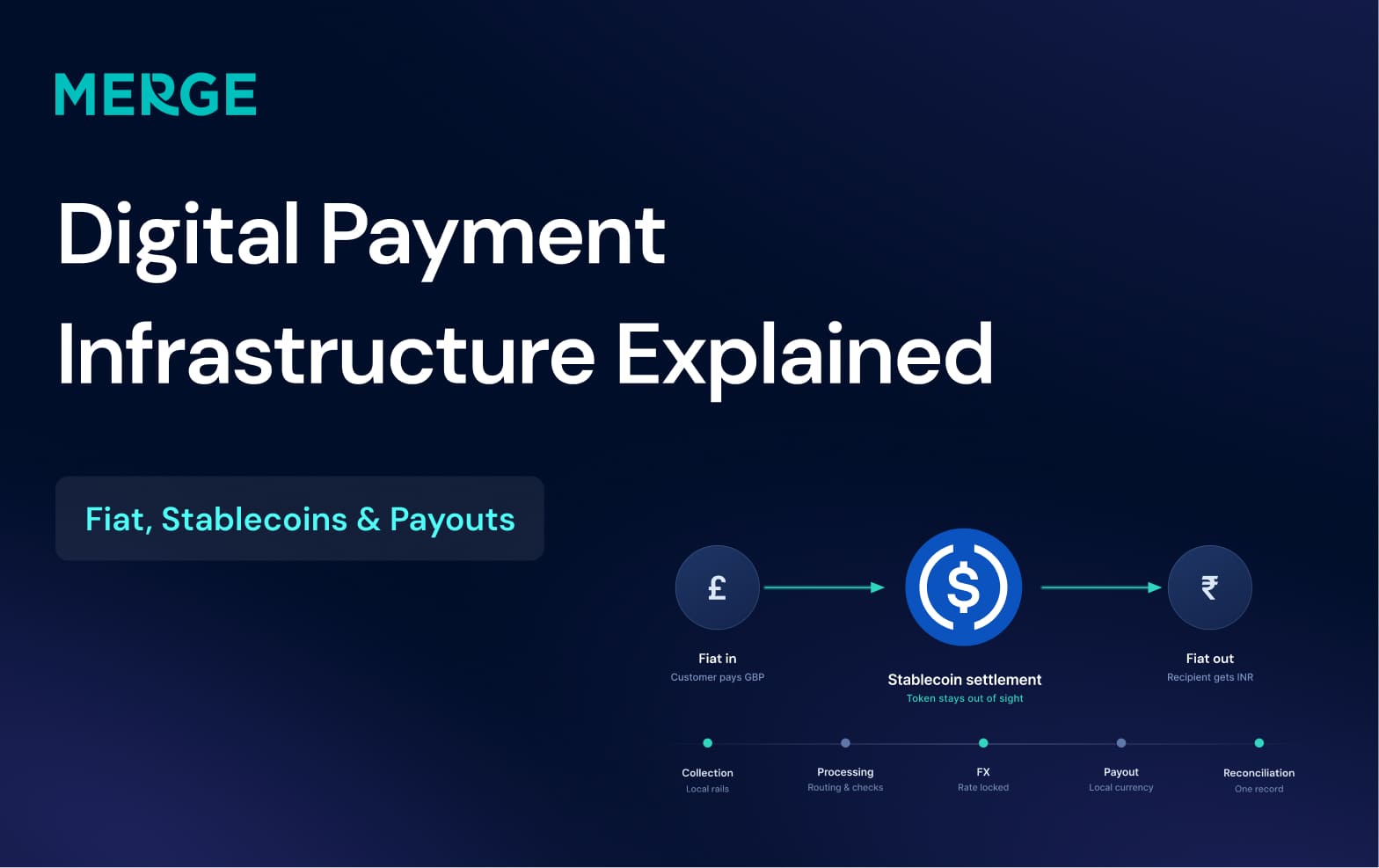
New infrastructure reduces the need for long correspondent chains. Instead of hopping from bank to bank, both sides use local payment rails. For example, a business in the Netherlands can pay euros into SEPA Instant, while the supplier in Brazil receives Brazilian real via Pix. Value moves globally in between, often via stablecoins, which provide an “always‑on” bridge between local systems. This model has three advantages:
- Faster settlement: Local real‑time payment rails such as SEPA Instant and the UK’s Faster Payments settle domestic transactions in seconds. FedNow in the US and UPI in India offer similar speed. When combined with stablecoins, value can travel 24/7 between regions without waiting for banking hours.
- Transparency: Stablecoin ledgers provide real‑time tracking of funds, reducing uncertainty about where money is in transit. This helps reconciliation and cash‑flow planning.
- Programmability: Programmable payments enable split disbursements and automated sweeps. Enterprises can route funds based on rules, rather than manually choosing rails.
Why B2B Cross‑Border Payments Are Slow and Expensive
Many of the challenges in B2B cross-border payments come from the infrastructure behind them. Multiple intermediaries, regulatory checks, and disconnected systems can increase costs and slow settlement.
Hidden Fees and Opaque FX Spreads
Foreign exchange remains the single biggest source of hidden cost in international payments. Traditional banks embed mark‑ups into exchange rates and layer on transfer fees, making it almost impossible for finance teams to predict the true cost of a cross‑border transaction.
Many companies default to sending payments from their home jurisdiction, even when the beneficiary is elsewhere. This leads to unnecessary intermediary fees and FX spreads. Corporations move $23.5 trillion across borders annually, so small basis‑point mark‑ups add up quickly.
Compliance and Screening Overhead
Each cross‑border payment is subject to sanctions screening, anti‑money laundering (AML) and know‑your‑customer (KYC) checks. A 2025 survey by the Association of Finance Professionals found that 79% of US organisations faced payment fraud attempts in 2024.
Every transaction that fails STP requires manual intervention, slowing settlement and increasing error risk. Globally, over 19,000 tax jurisdictions add further compliance complexity. As regulations tighten, businesses must navigate different KYC and AML requirements in each market.
Limited Visibility and Reconciliation Pain
In the legacy system, payment status updates are inconsistent. SWIFT data show that while roughly 90% of payments reach the recipient bank within an hour, the actual crediting of funds often occurs three to five days later. For finance teams, that delay translates into cash‑flow uncertainty. Matching incoming payments to invoices across multiple currencies and entities becomes a manual, error‑prone process. Low STP rates force staff to chase down confirmations and manually reconcile cross-border transactions across ERP systems and bank portals.
Trapped Capital and Nostro Accounts
To ensure smooth cross‑border settlement, banks hold foreign accounts (known as “nostro” and “vostro” accounts) with partners. Corporations often pre‑fund these accounts to guarantee liquidity. With global corporations moving trillions across countries each year, the amount of capital locked in nostro accounts is constantly fluctuating but consistently high. This trapped capital cannot be used for working‑capital needs or investment until the settlement is complete. The inefficiency is a key driver for alternatives like stablecoins, which allow value to move without large pre‑funded balances.
Types of B2B Cross‑Border Payment Solutions in 2026
Correspondent Banking
SWIFT is the global messaging network used by more than 11,500 institutions across over 200 countries. While GPI enhancements mean that 90% of payments reach the destination bank within an hour, full settlement still depends on correspondent chains, cut‑off times and currency availability. The model is well established but remains slow and expensive.
Card Networks
Business card rails allow enterprises to pay suppliers with credit or procurement cards. Virtual cards, which create a single‑use card number for each payment, are growing rapidly. Global virtual card payments are forecast to grow 235% by 2029, rising from $5.2 trillion in 2025. Cards are convenient for travel and ad‑hoc purchases but carry interchange fees and may not suit high‑value B2B transfers.
Money Transfer Operators and Fintech Rails
Modern providers combine local payment rails, FX liquidity and user-friendly interfaces. They connect to major networks such as ACH in the US, SEPA in Europe, Faster Payments in the UK, Pix in Brazil and UPI in India, while broader providers like Merge support local payment coverage across 80+ countries. These rails can speed up domestic settlement and, when orchestrated across borders, reduce settlement windows from days to hours. The main limitation is coverage, so businesses should check whether one provider can support their priority markets.
Stablecoin‑Based Infrastructure
Stablecoins pegged to fiat currencies provide a real-time bridge between local payment systems. After the GENIUS Act of July 2025 created a unified regulatory framework for fiat-backed stablecoins, institutional adoption accelerated. Businesses send local currency to a regulated provider, value moves across a blockchain as a stablecoin, and the recipient receives local fiat on the other side.
This is the model used by Merge. The platform combines stablecoin rails with local fiat payment networks, allowing businesses to collect and pay out in local currencies while stablecoins move value globally in between. Settlement is available 24/7, and payment flows can support features such as automated reconciliation, split payments, and sub-account structures. As with any stablecoin-based infrastructure, businesses should work with regulated providers and understand the compliance requirements in the markets where they operate.
What to Look for in a B2B Cross‑Border Payment Solution
When evaluating cross‑border payment providers, finance teams should consider:
- Coverage: Does the platform cover your high‑volume corridors and currencies? Look for access to major currencies and the ability to settle in local rails such as ACH, SEPA, Faster Payments, UPI, Pix and others.
- Compliance: Built‑in KYC/KYB, transaction monitoring, PEP screening and sanctions checks are essential. Global regulation is tightening, and fines for non‑compliance are substantial.
- Reconciliation and reporting: Automated reconciliation across currencies, sub‑accounts and entities reduces manual work and speeds month‑end close. Detailed reporting supports audit and tax requirements.
- API and integration: A single API that integrates with your ERP and treasury systems ensures straight‑through processing and reduces IT complexity. Look for SDKs and webhooks for real‑time status updates.
- Pricing: Transparent, flat‑fee pricing helps you forecast costs. Beware of hidden FX spreads and intermediary charges.
- Settlement speed: Real‑time rails with 24/7 availability improve cash flow and working‑capital efficiency. Near‑instant settlement reduces the need for large pre‑funding balances.
How Merge Approaches B2B Cross‑Border Payments
Merge combines stablecoin rails with local fiat payment networks. Because both sides use local fiat rails with stablecoins moving value in between, senders and recipients continue to transact in fiat without changing how they operate. The platform offers:
Local Fiat In, Local Fiat Out: Stablecoins in Between
Businesses collect and pay in local fiat. Stablecoins move value globally under the hood. Clients avoid opening foreign bank accounts or managing nostro balances. This model can reduce settlement times from days to near‑instant.
A Single API Platform
Open accounts, initiate swaps and trigger payouts through a unified integration. Instead of managing multiple banking relationships, businesses interact with one API. Merge can connect to multiple local payment rails and route payments via the optimal rail for each corridor.
Built‑in Compliance
KYC/KYB, transaction monitoring, PEP screening, sanctions checks and regulatory workflows run in the background. Compliance controls are updated continuously to reflect local regulations.
Fast Global Payouts
Merge allows clients to collect locally and pay out globally. It connects to local payment rails worldwide and can settle via ACH, SEPA, Pix, Faster Payments, UPI and more, with fast settlement to major markets, same-day payouts to supported corridors, and near-instant stablecoin disbursement where local rails are slower. Structured reconciliation data and reporting support sub-accounts and split payments. Settlement is available 24/7 with no banking‑hour restrictions.
Reconciliation and Sub‑Accounts
Dedicated sub-accounts keep funds segregated and traceable, so each flow maps cleanly to a counterparty, entity, or cost centre. Merge surfaces a single, structured payment-data layer that makes matching structural rather than manual, giving finance teams the visibility and data hooks to automate reconciliation on clean data. Configurable rules support sweeps and splits by client or transaction type
Transparent Pricing
Merge charges with flat fees that businesses can forecast. There are no hidden surprises in FX spreads or intermediary charges.
Regulated Status
Merge operates as a Virtual Asset Service Provider (VASP) regulated by the AMF in France. It also holds an EMI licence, allowing it to issue fiat accounts to customers in Europe and provide access to SEPA Instant, SEPA Credit Transfer and TARGET2 transactions. Merge does not hold client funds or control wallets; it orchestrates payments across banks, local rails and stablecoin issuers. Every transaction includes automated PEP screening, sanctions checks, KYC/KYB and ongoing transaction monitoring.
Marketplace Line
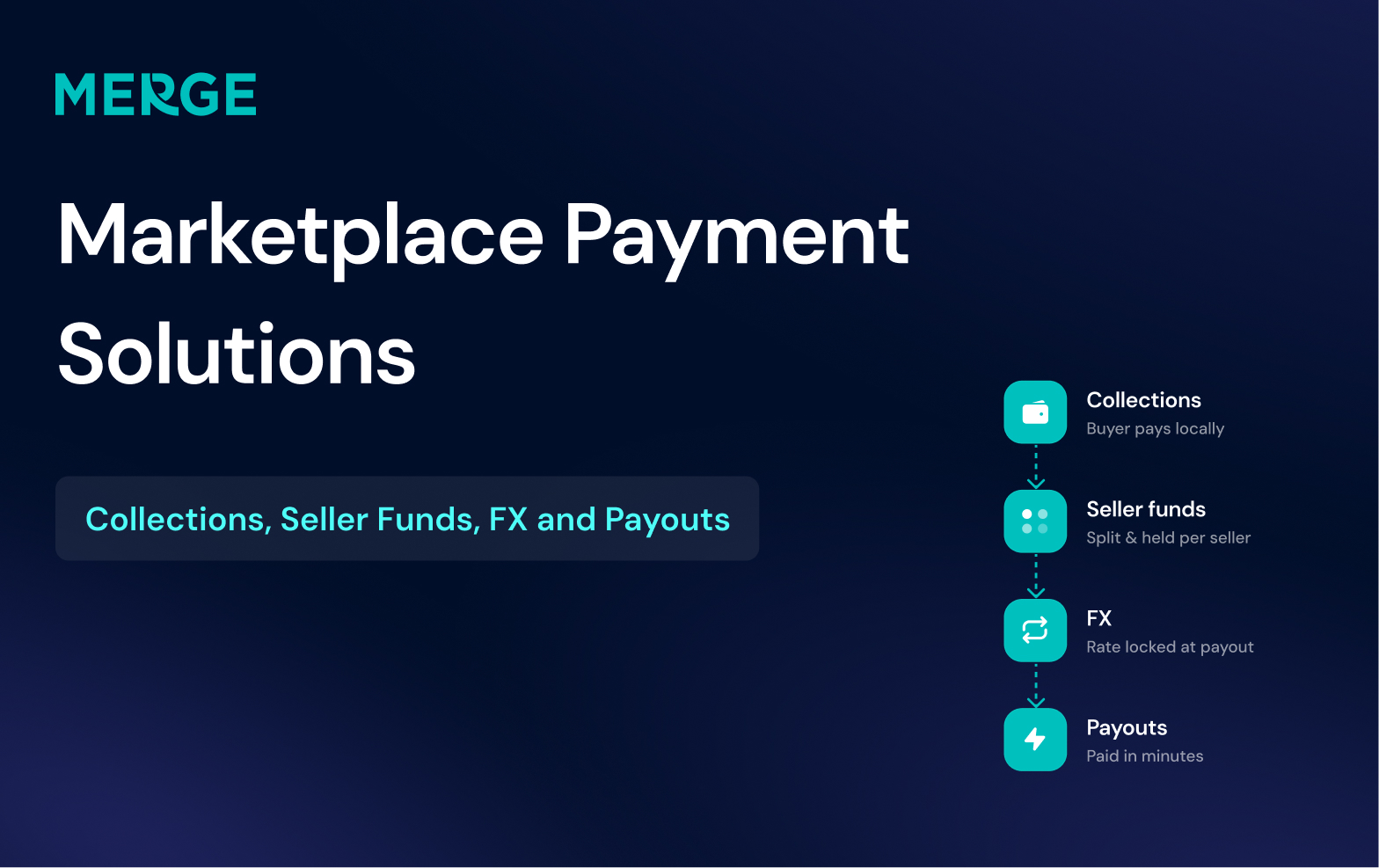
For platforms that collect and split funds across buyers, sellers and regions, Merge can simplify reconciliation and reduce complexity by handling settlement, sub‑account management and splits through a single integration.
B2B Cross‑Border Payments by Use Case
- Fintechs & Banks: Offer cross-border payment services to customers, businesses, and partners. Modern infrastructure helps financial institutions connect to local payment rails, support global pay-ins and pay-outs, streamline compliance workflows, and move funds across multiple countries through a single integration.
- Marketplaces: Collect payments from buyers in one currency and pay sellers in another. A cross‑border solution should handle split payments, sub‑accounts and automated reconciliation.
- Commodity Trading Firms: Manage supplier payments, trade settlements, and treasury flows across global markets. Modern payment infrastructure helps trading firms move funds between counterparties, reduce operational complexity, improve payment visibility, and support compliance across multiple countries and currencies.
- Payroll platforms: Pay freelancers and remote employees around the world. Merge powers the cross-border payout leg, fast, local-currency disbursement via local rails or stablecoin, while the payroll platform handles calculation, payslips, and tax reporting.
- Digital asset companies: Exchanges, brokers and crypto wallets need on‑ and off‑ramps between fiat and stablecoins. A solution that handles both fiat rails and stablecoins can simplify treasury operations.
- AI Platforms: Collect payments from customers, pay suppliers, and manage global fund flows as usage grows across markets. Modern payment infrastructure helps AI platforms support international collections and payouts, automate reconciliation, and move funds across multiple countries through a single integration.
- Brokerages: Manage client deposits, withdrawals, and cross-border fund movements across multiple markets. Modern payment infrastructure helps brokerages support global collections and payouts, improve transaction visibility, automate reconciliation, and maintain compliance across jurisdictions.
2026 Trends in B2B Cross‑Border Payments
- Rise of stablecoin rails: Regulatory clarity has accelerated institutional adoption of fiat‑backed stablecoins. Cross‑border payment platforms increasingly use stablecoins between local rails to achieve 24/7 settlement and reduce the need for nostro accounts.
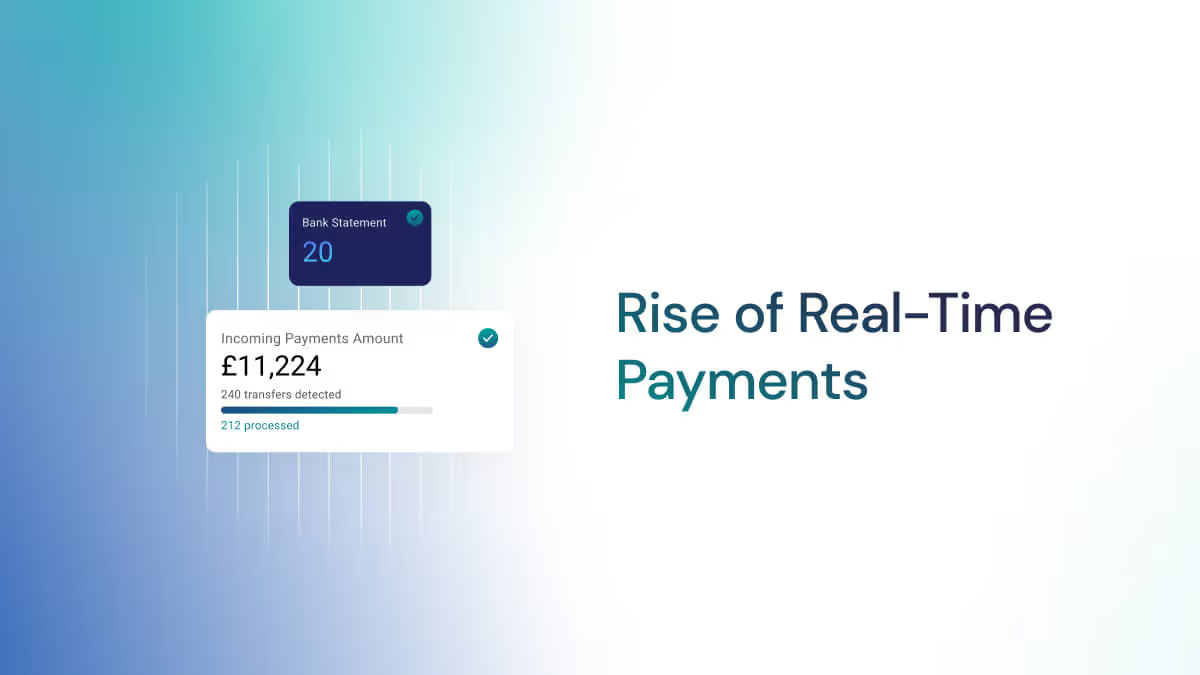
- Real‑time payment links go global: Domestic instant payment systems like FedNow, UPI and Pix are being connected across borders, compressing settlement windows from days to seconds. Initiatives such as the G20 Cross‑Border Payments Roadmap aim to standardise data and messaging for interoperability.
- Stronger regulation and compliance automation: With payment fraud on the rise, regulators are tightening KYC and AML standards. New rules require structured data (ISO 20022) and standardised address formats. Businesses adopt AI‑powered monitoring to keep pace.
- Smarter compliance: Machine learning models identify suspicious patterns and reduce false positives, improving straight‑through processing. Providers embed transaction monitoring into APIs to offload compliance burden from clients.
- More programmable flows: Enterprises are turning to programmable payments to automate multi‑party settlements, revenue sharing and escrow release. Smart contracts built on regulated blockchains facilitate conditional payments without manual intervention.
Merge brings these innovations together. Connecting to local payment rails and using stablecoins for value transfer allows businesses to collect and pay in local currency while value moves globally. Built‑in compliance, intelligent reconciliation and a single API provide the operational backbone for your cross‑border payment needs.
Talk to Merge to explore how modern infrastructure can simplify your international payments and help you expand globally.
FAQ
What are B2B cross‑border payments?

B2B cross‑border payments are transactions where one business pays another in a different country and currency. They cover supplier payments, payroll, marketplace payouts and treasury transfers, and traditionally rely on chains of correspondent banks that add fees, FX spreads, compliance checks and settlement delays.
How do B2B cross‑border payments work?
Traditionally, funds pass through a chain of correspondent banks, each applying fees, FX spreads, and compliance reviews before the money arrives. Modern infrastructure keeps both ends on local payment rails and uses stablecoins to move value in between, so businesses transact in local currency without changing how they operate.
What are the biggest challenges of cross‑border payments?
The main challenges are cost, speed, transparency and compliance. Multiple intermediaries add hidden fees and opaque FX spreads, settlement can take days, payment status is hard to track, and each jurisdiction adds regulatory and screening requirements that businesses must manage across many banking relationships.
What are the benefits of stablecoin‑based payments versus traditional rails?
Stablecoin‑based infrastructure can simplify settlement, improve transparency and reduce operational complexity. It enables programmable payment flows, including split payments and automated reconciliation. Businesses send and receive local currency while value moves via stablecoins under the hood. This approach offers 24/7 settlement and real‑time tracking but requires working with regulated partners.
Is Merge a regulated provider?
Yes. Merge operates as a Virtual Asset Service Provider (VASP) regulated by the AMF in France. Every transaction includes automated PEP screening and sanctions checks, with KYC/KYB and transaction monitoring handled in the background. Merge provides payment infrastructure; it does not hold custody of client funds.
Disclaimer: This content is intended for informational purposes only. It should not be considered financial, legal, or operational advice. Businesses should evaluate their own compliance, regulatory, and infrastructure requirements before implementing payment solutions.