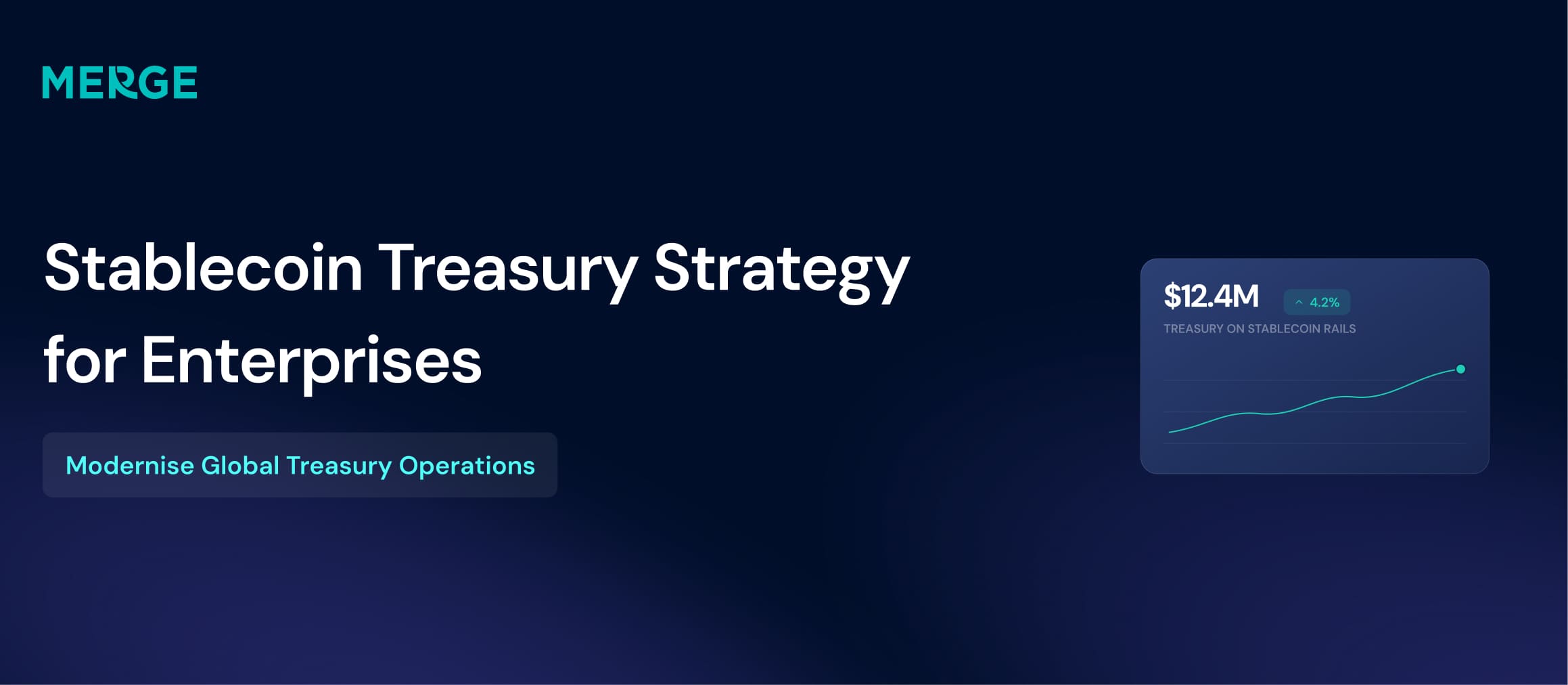


Stablecoin Treasury Strategy for Enterprises
- A stablecoin treasury strategy for enterprises uses digital tokens for settlement, not corporate speculation.
- Start with one corridor. Set limits for funding, conversion, approvals, redemption and exceptions.
- The right operating layer joins fiat accounts, stablecoin rails, local payouts and reconciliation.
A multinational collects euros, pays suppliers in rupees and funds payroll in pesos. Its cash sits across legal entities, bank accounts and payment providers. Cut-off times slow transfers. Different data formats turn reconciliation into detective work.
The hard part is not moving money once. It is moving money every day, across currencies and borders, with control. A stablecoin treasury strategy for enterprises offers a settlement route for selected flows. It does not remove the need for banks, FX, local rails or treasury discipline.
What Is a Stablecoin Treasury Strategy?
A stablecoin treasury strategy is a plan for using stablecoins in payment and liquidity operations. The business treats the token as a controlled settlement medium between fiat funding and fiat payout. It does not treat the token as an investment.
The plan defines five building blocks:
- Approved use cases, entities and corridors
- Liquidity, stablecoin and currency rules
- Payment limits and approval rights
- Issuer, provider and network checks
- Reconciliation, reporting and recovery plans
It names the fund owner, exposure limit, approver and ERP records. It sets the response to a failed conversion or payout.
Why Are Modern Treasury Teams Testing Stablecoin Rails?
The phrase modern treasury stablecoins reflects a plain operating problem. Global firms use many currencies, entities and local payment methods. Cash can become stranded in regional accounts. Bank holidays and cut-off times delay rebalancing. Treasury data then arrives through separate portals, files and provider feeds.
Stablecoin rails offer a more continuous settlement leg outside normal correspondent-banking windows. A shared operating layer can join execution, conversion data, references and status events.
This remains an early market. The European Central Bank reported that stablecoin market capitalisation exceeded US$300 billion by the end of 2025, 50% higher than in 2024. Despite that growth, estimated stablecoin payments still account for less than 0.01% of B2B or B2C payment activity. Treasury teams have room to test the rails, but no basis for blind adoption.
Stablecoins do not eliminate cash management. A corporate treasury still needs bank access, local payout routes, FX controls and clear ownership. The settlement path changes. The duty to control the payment does not.
Searches for modern treasury stablecoins often imply a technical purchase. Yet a wallet alone cannot set entity limits, resolve exceptions or post clean ERP records.
What Are the Five Benefits of Stablecoin Treasury Management?
The benefits depend on the corridor, counterparties and operating design. Measure the full payment journey, not the on-chain transfer alone.
1. More Continuous Liquidity Movement
Stablecoins can carry the settlement leg across time zones. End-to-end access can still slow at the fiat edges. A bank review or local rail can add time.
2. Fewer Operational Handoffs
Teams often use separate firms for accounts, FX, conversion and reporting. Stablecoin treasury management can put those steps into one controlled sequence. Treasury responsibility remains.
3. Clearer Treasury Visibility
Each record can carry the entity, beneficiary, invoice, rate and payment state. Structured events feed finance systems. Treasury sees cash in transit and open exceptions.
4. Programmable Workflows
APIs can apply maker-checker approval, counterparty lists and transaction ceilings. Webhooks can report conversion, transfer and payout events. Policy becomes repeatable across entities.
5. More Flexible Global Operations
Suppliers, contractors and sellers do not need to receive tokens. Fiat can enter through a local account. A stablecoin can carry the middle leg. Fiat can then leave through a domestic payout rail. Merge’s stablecoin treasury management infrastructure combines on-ramping, multi-currency accounts, payment rails and reconciliation through one API.
Liquidity Management for Stablecoin Payments
Stablecoins do not solve liquidity management. They redesign where liquidity sits, how it converts and which party carries each risk.
Good liquidity management for stablecoin payments does not maximise token balances. It keeps token exposure tied to a payment purpose and an approved duration. Many firms will prefer just-in-time conversion or short holding periods. That choice reduces idle digital-asset balances, but it increases reliance on conversion access at the payment time.
Prefunding needs the same care. Faster settlement can reduce some regional buffers. It cannot remove the need to fund payments. Risk can move from a prefunded bank account to an issuer, liquidity provider or off-ramp. A network that settles in seconds cannot make local fiat appear during a bank closure.
Set a baseline before the pilot. Record idle balances, end-to-end delivery time, FX spreads, provider fees, failed payments and manual reconciliation hours. Compare the same corridor, value band and payout method. Savings claims mean little without that like-for-like test.
Review it each quarter. Liquidity management for stablecoin payments changes with coverage, redemption terms and local rails.
What Do Orchestration Platforms for Treasury Actually Do?
Orchestration platforms for treasury coordinate the complete payment sequence. They connect account balances, approvals, compliance checks, conversion, stablecoin settlement, local delivery and finance records.
Treasury orchestration flow:
Strong stablecoin orchestration platforms for treasury track each state through a shared payment ID. They send status events through APIs or webhooks. They surface exceptions with enough context for an operator to act. They support fallback routes under an agreed policy.
That operating layer should coordinate:
- Accounts and balances
- Payment initiation and approvals
- KYB, transaction monitoring and sanctions checks
- FX and stablecoin conversion
- Network and provider routing
- Local payout instructions
- Reconciliation, reports and audit data
- Returns, failures and manual review
The platform does not remove finance-team oversight. It applies that oversight in the same way across entities and payments. Direct token transfer is only one step. Stablecoin orchestration platforms for treasury must control the steps on both sides of it.
Merge’s orchestration platform links fiat conversion, routing, on-chain settlement, local delivery and reconciliation. Its API design gives treasury and ERP systems a single control point.
Which Enterprise Use Cases Fit this Model?
The model suits recurring flows where payment timing, cash visibility or reconciliation creates a clear operating problem.
Intercompany Liquidity Movement
A central treasury can fund or rebalance a regional entity through an approved corridor. The policy should state the business purpose, ownership and local reporting treatment.
Supplier and Vendor Payments
A company can pay an overseas supplier in local currency. The stablecoin remains inside the settlement path. The supplier keeps its normal bank-account experience.
Contractor and Payroll Disbursement
Payroll or HR systems approve the file and calculate pay. The payment layer executes the cross-border disbursement. Local employment, tax and payroll duties stay with the employer or payroll provider.
Marketplace Disbursements
A marketplace can collect in one market and pay sellers in others. Named sub-accounts can separate balances by seller, entity or order. Structured records reduce manual matching.
Revenue Repatriation
A regional business can move collections into a central treasury structure. Legal permissions, tax treatment and currency controls need a corridor review first.
Each use case needs a measurable starting point. Pick a recurring flow with known delays, fees or reconciliation effort. Do not start with every entity and currency.
Which Risks and Controls Must Treasury Teams Cover?
Stablecoin settlement changes the payment route, but it creates a set of risks that treasury must own and test.
Issuer and Redemption Risk
Check the legal issuer, reserve composition, assurance reports and direct redemption rights. Review fees, minimums, operating hours and suspension terms. The Financial Stability Board calls for clear redemption rights, transparent reserves and recovery plans.
Issuer terms differ. Circle publishes weekly USDC reserve holdings and monthly third-party assurance. Tether reports circulation more often and publishes quarterly reserve reports. Its direct redemption terms include eligibility, minimums and possible suspension. Treasury diligence must examine the contract, not just the peg.
Liquidity and FX Risk
Set rules for conversion timing, currency mismatch, rate approval and provider concentration. Test funding during market stress. Track the full spread and every fee. Keep a fallback for unavailable conversion or redemption.
Compliance and Sanctions Risk
Stablecoin payments remain payment activity. OFAC states that its sanctions duties apply equally to virtual currency and fiat transactions. Screening should cover clients, counterparties, wallet addresses, ownership and geography. Local duties vary. The business and its providers need a written allocation of work.
Operational and Technology Risk
Wrong wallet details can cause permanent loss. Provider outages can halt conversion or payout. APIs can fail, credentials can leak, and records can fall out of sync. Use address controls, role-based access, maker-checker approval, alerts and tested recovery steps.
Governance Risk
Name an owner for policy, provider review and incidents. Set approval limits and segregation of duties. Keep complete audit records. Test business continuity and exit plans. Review every corridor after a legal, provider or network change.
Stablecoin Treasury and Crypto Treasury Compared
Enterprise stablecoin treasury management does not require a speculative balance-sheet position. A firm can limit token exposure to the settlement window. It can keep its invoices, operating balances and finance records in fiat.
This distinction protects the business case. The goal is better payment control, not a view on token prices.
How Do You Build a Stablecoin Treasury Strategy?
- Map the present flow. List accounts, entities, currencies, providers, cut-off times, fees and manual work.
- Choose one measurable use case. Select one intercompany route, supplier corridor or payout flow.
- Write the treasury policy. Set approved entities, tokens, networks, counterparties, value limits and holding periods.
- Complete partner checks. Review the account provider, issuer, liquidity source, conversion route and payout firm.
- Connect operational data. Send balances, rates, payment states and exceptions to the ERP or treasury system.
- Pilot and measure. Compare delivery time, idle cash, total cost, failure rate and staff effort with the old route.
- Expand by evidence. Add a corridor only after the first flow meets its control and performance targets.
Build the Settlement Route around Treasury Control
The strongest stablecoin treasury strategy for enterprises does not seek larger digital-asset balances. It moves corporate liquidity through defined corridors, controlled conversion and clear approvals. It records each step and keeps a fallback ready.
Talk to Merge about a treasury and liquidity-workflow assessment for your entities, currencies and payment corridors. You can then explore Merge’s stablecoin payments API for the operating infrastructure behind the flow.
FAQ
What is stablecoin treasury management?

Stablecoin treasury management uses stablecoins as a settlement medium for approved payment and liquidity flows. It connects fiat funding, conversion, stablecoin settlement, local payouts and reconciliation under one treasury policy.
Is stablecoin treasury management the same as crypto treasury management?
No. Crypto treasury management often concerns custody, allocation or investment in volatile crypto assets. Stablecoin treasury management focuses on payment execution, liquidity movement and treasury control. A business can keep its operating balances and reporting in fiat.
Do stablecoins remove the need for banks or FX?
No. Stablecoins can change the cross-border settlement leg. Fiat still enters and leaves through regulated accounts and payment rails. Treasury teams still need FX rules, bank access, approval limits and payment controls.
Can stablecoin settlement reduce prefunding?
It can reduce selected regional buffers where a business needs faster funding or rebalancing. It does not remove the need to fund payments. Treasury must assess conversion access, redemption timing, provider exposure and local payout availability.
What should an enterprise test first?
Start with one recurring payment corridor. Measure delivery time, idle liquidity, total cost, failed payments and reconciliation effort. Add new corridors only after the first pilot meets its control and performance targets.
Disclaimer: This content is intended for informational purposes only. It should not be considered financial, legal, or operational advice. Businesses should evaluate their own compliance, regulatory, and infrastructure requirements before implementing payment solutions.


Ready to see what Merge can do for you?
Related Articles