

Digital Payment Infrastructure Explained: The Fiat-Stablecoin-Fiat Technology Stack
- Digital payment infrastructure joins collection, processing, FX, settlement, payout and reconciliation in one flow.
- A fiat–stablecoin–fiat model uses stablecoins inside the settlement layer. Customers do not need to hold tokens.
- A production payment stack needs clear data ownership, compliance controls, liquidity plans and named exception owners.
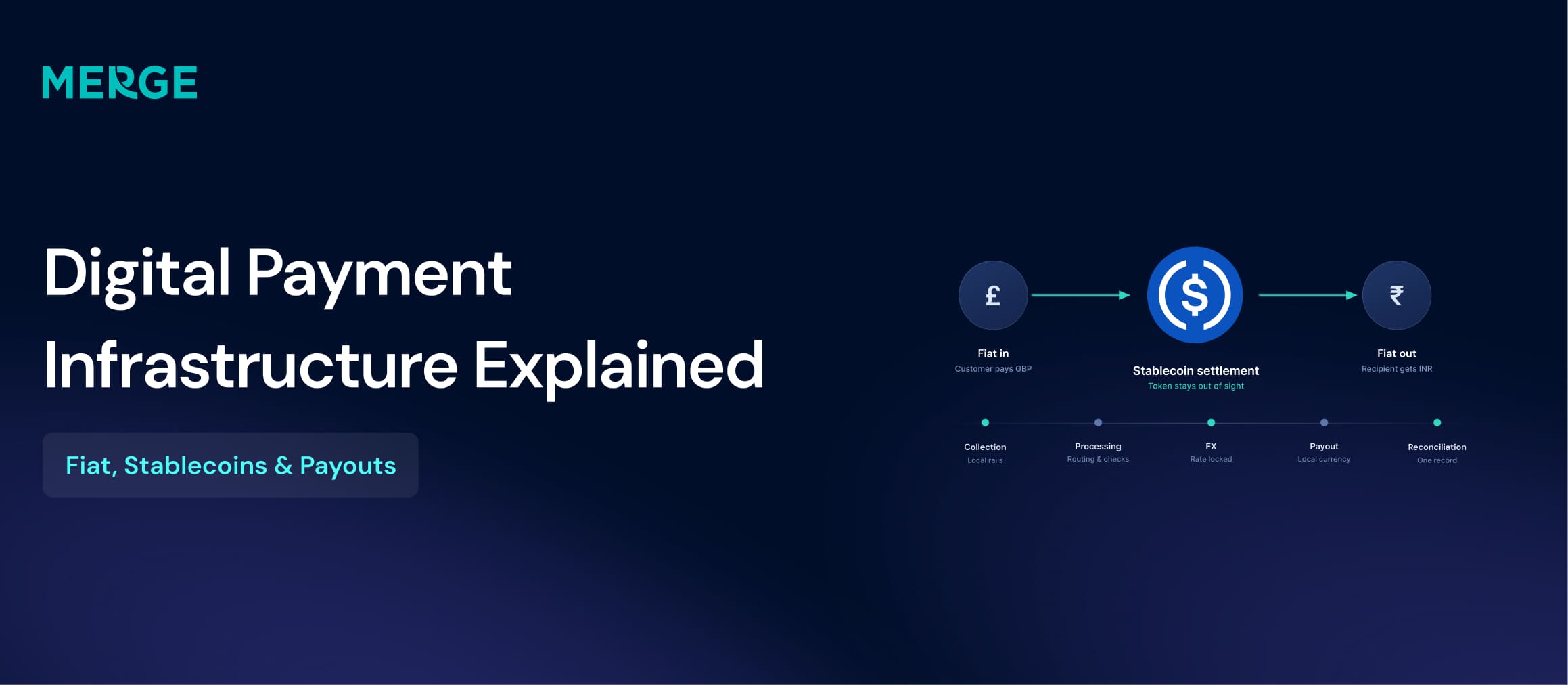
Digital payment infrastructure is the technology that collects, routes, settles and records payments. In a fiat–stablecoin–fiat flow, customers pay in local currency. Value then moves through a stablecoin settlement route. A local payout rail delivers the recipient's chosen currency. The token can remain out of sight at both ends.
The hard part is not one fast transfer. It is keeping every stage controlled and tied to one payment record. That means linking banks, screening tools, FX, blockchain networks, payout partners and internal ledgers.
What Is Digital Payment Infrastructure?
Digital payment infrastructure is the operating and technology layer beneath a payment product. The app or checkout is the visible front. The infrastructure does the work below it.
It receives an instruction, identifies the parties and checks available funds. It screens the transaction, chooses a route and records any currency conversion. Next, it moves value through a settlement rail. A payout partner then delivers funds and reports the result.
That definition covers far more than a card form or mobile wallet. The full layer can include:
- customer and business payment channels
- local collection rails
- processing and route selection
- identity, fraud and sanctions controls
- accounts and balance records
- FX and conversion
- settlement rails
- local payout partners
- webhooks and status updates
- reconciliation and reporting
The European Central Bank defines a payment system as instruments, banking procedures and interbank funds-transfer systems. Modern digital payment technology stretches that model across APIs, new ledgers and many providers. Several digital payment systems can sit behind one product. The job stays familiar. Move the right amount to the right recipient, then prove what happened.
What are digital payments? They are transfers of monetary value initiated, processed or recorded through electronic channels. A digital payment still needs a route, control points and a reliable record.
The Fiat–Stablecoin–Fiat Payment Stack
The complete flow looks like this:
Sender → local fiat collection → payment checks and conversion → stablecoin settlement → conversion and local payout → recipient → ledger and reporting
Each layer has a separate job.
The diagram looks linear. Production payment flows rarely are. A screening hold can pause conversion. A stale quote can require a new rate. A payout can fail after successful on-chain settlement. Good digital payments technology models each state and every permitted transition.
How Fiat Collection Works?
Every fiat-funded payment starts with a collection event. The sender uses a bank transfer, local payment method or supported card. Named accounts or virtual account details can give the sender a distinct destination.
The collection record needs more than an amount. Useful fields include currency, value date, payer identity, account, reference and funding status. Returns and failed collections need their own states. Reusing a success state for a returned payment creates false balances later.
A shared payment ID should connect collection to the final payout. That ID should survive provider hand-offs. The BIS Nexus specification uses a unique end-to-end reference for each cross-border payment. The principle works for any architecture. A stable identifier turns scattered events into one traceable journey.
What Happens During Digital Payment Processing?
Digital payment processing validates the instruction and decides what happens next. It can check customer or business records, sanctions exposure, fraud signals and approval limits. It can then choose a provider, rail and currency route.
Processing should return a clear state. Examples include accepted, rejected, under review, funded, conversion pending and payout pending. Webhooks should carry the payment ID, event time, prior state and new state. Idempotency controls stop a retry from creating a duplicate transfer.
Processing can finish before the recipient receives money. This fact should shape the API. A processed response cannot stand in for paid_out. Product screens, support tools and finance reports must preserve that difference.
Data quality belongs inside digital payment processing, not after it. The CPMI'sFebruary 2026 update on ISO 20022 says 79% of surveyed RTGS and fast-payment systems had adopted the standard or planned to do so. Rich, structured fields support screening, routing, investigations and reconciliation. A faster rail cannot fix a truncated beneficiary name.
Where Stablecoins Fit into Payment Infrastructure?
Stablecoins can replace part of the settlement route, not the whole digital payment system. In a fiat–stablecoin–fiat flow, the sequence runs like this:
- The sender funds a payment in fiat.
- The route completes required checks.
- A provider converts fiat into an approved stablecoin.
- The stablecoin moves across the chosen network.
- A recipient-side provider converts value into fiat.
- A local rail pays the recipient.
- Payment data returns for reconciliation.
Fiat-backed stablecoins aim to track a reference currency through reserve assets and redemption rights. They still carry issuer, reserve, legal, network and redemption risk. Fiat-backed stablecoins are not risk-free cash. The review must cover the exact issuer, token, chain, provider roles and jurisdictions.
The customer experience can stay fully in fiat. A buyer pays pounds. The settlement layer uses a dollar-linked token. The supplier receives pesos. Neither party needs a wallet or a crypto balance.
An on-chain confirmation marks one technical event. It does not prove successful off-ramping or recipient credit. A 2026 BIS study of stablecoin activity found that treating each transfer event as a standalone payment misclassified almost six in ten events. Smart-contract transactions can bundle trading, lending, liquidity and settlement actions. The ledger shows what moved on-chain, not the full commercial story.
Rules travel with the payment too. The European Banking Authority's transfer guidance sets out information requirements for fund and crypto-asset transfers. It covers missing or incomplete payer and payee data. A blockchain address alone is not enough for a controlled cross-border payment.
FX, Liquidity and Local Payouts
Most route failures occur near the fiat edges. The settlement leg can run correctly, yet the destination lacks liquidity. A receiving bank can reject the beneficiary details. A local rail can close for a holiday. An off-ramp can apply limits or enter review.
Route design must cover:
- source and destination currencies
- FX quote, rate and fee data
- quote expiry and conversion time
- available liquidity at both ends
- local payout coverage and cut-off times
- recipient account validation
- payout failures, returns and reversals
- backup routes and manual intervention points
Liquidity deserves special attention. Faster settlement changes where money waits. It does not remove the need for available fiat at the exit. A route can reduce prefunding in one country and shift it to a provider elsewhere.
Measure the full journey, not the quickest component. The Financial Stability Board's cross-border targets call for cost, expected delivery time, status tracking and service terms to reach payers and payees by the end of 2027. That is a useful product requirement now. Show the quote, likely arrival time and current state before users ask support.
Why Reconciliation Belongs in the Architecture?
A payment is not operationally complete until its records agree. Payment reconciliation connects the sender's instruction to money movement and finance treatment.
Blockchain data can support reconciliation. It does not replace the business's internal ledger, approval rules or audit trail. The on-chain record lacks many business facts. It may not hold an invoice number, cost centre, fee treatment or final payout state.
Good architecture records expected and actual values. It records who approved the payment, which quote applied and which provider handled each leg. It keeps the raw provider payload for investigation. It never overwrites an earlier state.
Named sub-accounts can improve matching at source. One account can map to one entity, seller, counterparty or business line. The client still owns its accounting rules and internal ledger treatment.
Merge's payment reconciliation layer exposes incoming and outgoing records, balances and settlement confirmations. Clients consume that structured data in their own accounting, ERP or treasury tools. Unmatched items can trigger alerts or enter a finance operations queue.
What a Production-Ready Payment Stack Needs
A sound build needs more than working endpoints. Use this checklist for technical, product, finance and compliance reviews:
- One shared payment ID across every provider
- Structured API responses and versioned webhook events
- Clear states for collection, conversion, settlement and payout
- Idempotency keys and duplicate-payment controls
- KYC, KYB, KYT, sanctions and fraud checks at agreed points
- Recorded FX quotes, fees and converted amounts
- Settlement proof and recipient-side payout evidence
- Exception queues with severity, age and named owners
- Reconciliation data for the internal ledger
- Provider health monitoring and incident procedures
- Role-based access, maker-checker approval and audit logs
- Tested returns, reversals and manual recovery paths
The best test is not the happy path. Try a valid payment with an expired FX quote. Confirm an on-chain transfer, then reject the bank payout. Deliver the same webhook twice. Remove a beneficiary field. Pause one provider mid-route. Each test reveals whether the architecture controls money or merely calls APIs.
How Merge Connects the Payment Layers
Merge connects local collection, FX, stablecoin settlement routes, local payouts and payment data through one API. Businesses can build a fiat–stablecoin–fiat flow across supported corridors without asking end users to handle crypto.
Its stablecoin payments API provides a single integration point for accounts, conversion, settlement and payouts. Stablecoin orchestration coordinates route selection, provider hand-offs, status and exceptions. Multi-currency accounts can separate balances by entity or counterparty. Merge's on-ramp and off-ramp infrastructure connects fiat entry and exit points.
Teams can use the same structure for supplier payments, marketplace payouts, contractor disbursements and inter-company transfers. Merge'scross-border payments page shows the supported business use cases.
Coverage varies by corridor, product and onboarding terms. Merge does not replace a client's core ledger, accounting policy or governance. Each client retains responsibility for provider oversight and its own legal obligations.
Start with One Payment Route
Do not launch ten corridors to prove one design. Start with one source country, one destination country and one currency pair. Pick one collection method, one payout rail and one clear use case.
Track seven measures:
- collection success rate
- processing time
- conversion time
- settlement confirmation time
- recipient payout success rate
- reconciliation match rate
- exception-resolution time
These figures show where the route really slows or breaks. A two-second on-chain transfer means little after a six-hour payout delay. A cheap settlement leg can hide a costly FX spread or manual investigation.
The right first milestone is a reconciled payout, not a blockchain transaction. Once that route works under failure tests, add the next corridor. Teams comparing digital payment solutions should judge the full path on delivery, data quality, control and recovery.
Book a payments architecture assessment for one corridor, one payment flow and a clear control map. You can explore Merge's API documentation first.
FAQ
What is digital payment infrastructure?

It is the technology and operating layer that collects, checks, routes, settles, pays out and records money movement. It joins payment channels, local rails, FX, controls, settlement, webhooks and finance data.
How does a fiat-stablecoin-fiat payment flow work?
The sender pays fiat through a local rail. A provider checks and converts the funds into a stablecoin. The token moves across a blockchain network. A recipient-side provider converts it back and pays local fiat.
Do customers need to hold stablecoins to use stablecoin payment infrastructure?
No. Stablecoins can sit behind the product experience as a settlement asset. The sender and recipient can use local currency at each end.
What is a digital payment system?
It is the end-to-end set of technology, providers, rules and records behind a payment. It tracks the sender's instruction through collection, processing, settlement, recipient delivery and ledger matching.
Why does reconciliation belong in the payment flow?
Reconciliation proves that the instruction, collection, conversion, settlement, payout and internal ledger agree. It flags missing, duplicated, delayed or unmatched records for review.
Disclaimer: This content is intended for informational purposes only. It should not be considered financial, legal, or operational advice. Businesses should evaluate their own compliance, regulatory, and infrastructure requirements before implementing payment solutions.