

How UBS Tested Real-World Stablecoin Payments with Merge
- UBS completed its first worldwide stablecoin payments under real-world conditions with corporate clients and Merge.
- B2B payments took seconds rather than days. Transfers from Switzerland to several countries took less than two minutes.
- Merge served as the stablecoin payment provider. The public record does not name the currencies, stablecoin, network, volumes or full project design.
In July 2026, UBS completed its first real-world stablecoin payments with Merge. UBS shared the results after testing cross-border B2B transfers with corporate clients under real-world conditions. The Proof of Concept, or PoC, moved B2B payments in seconds rather than days. Transfers from Switzerland reached several countries in under two minutes.
UBS is one of the world’s largest wealth managers and Switzerland’s leading universal bank. Headquartered in Zurich, it operates in more than 50 markets and managed US$6.9 trillion in invested assets at the end of Q1 2026. Its size and global reach make this stablecoin project a major test for cross-border corporate payments.
This was a live test, not a paper exercise. It showed how banks and financial institutions can test stablecoin rails for real cross-border payments. It did not announce a full production launch.
The UBS and Merge Case Study at a Glance
The Challenge: Long Payment Chains and Limited Visibility
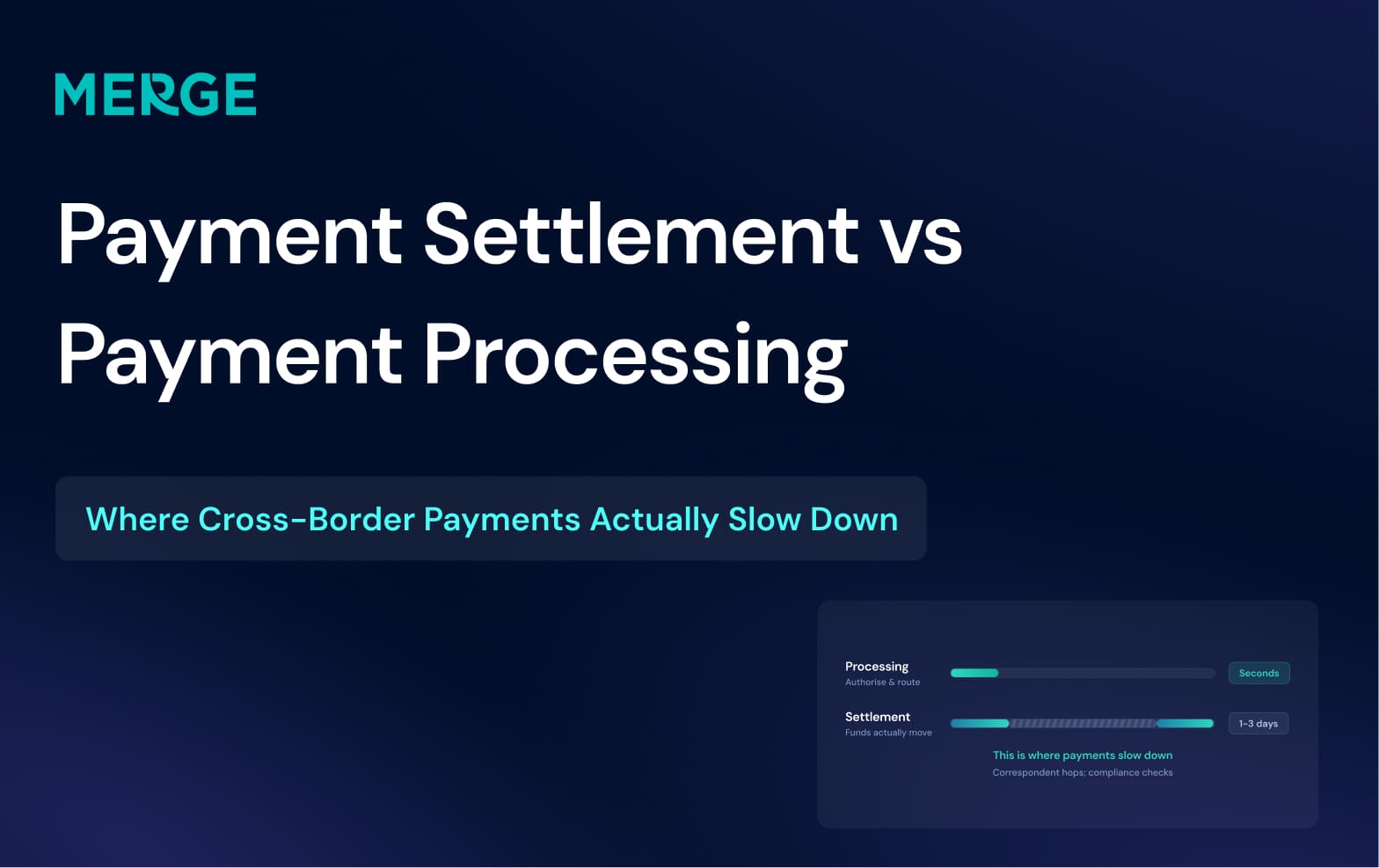
Cross-border corporate payments often pass through several correspondent banks. Each party adds its own checks, cut-off times and records. A payment can take days to arrive. Its status can remain split across several systems.
That structure puts pressure on B2B payments processing. Treasury teams need clear delivery times and reliable transaction data. Corporate clients want funds to reach the right account without repeated tracing work.
This problem affects B2B payment services across many markets. It shapes the work of banking and financial services teams. Older cross-border payment systems can make a simple transfer feel like a chain of separate jobs.
The PoC tested a more direct path. Stablecoins carried value between markets, and Merge joined as the stablecoin payment provider. The test used real corporate client payments rather than a closed lab scenario.
Why UBS Worked with Merge
UBS selected Merge as the stablecoin payment provider for the PoC. Merge connects local fiat payment rails with stablecoin settlement through its regulated payments infrastructure. Its standard flow accepts local money, converts it into stablecoins, moves funds on-chain and pays out through local rails.
That model treats a stablecoin as a payment rail, not a client investment. With Merge, senders and recipients can keep using fiat. This design gives banks and financial institutions a link between bank money and on-chain settlement.
Merge provided the infrastructure that connected traditional payment rails with stablecoin settlement. This gave UBS a faster route for cross-border transfers, clearer transaction tracking and a practical way to test stablecoin payments with corporate clients.
How the Stablecoin Payment PoC Worked
The project covered four main areas:
- UBS worked with corporate clients and Merge.
- The team tested B2B payments under real-world conditions.
- Payments travelled from Switzerland to several countries.
- Payments completed in seconds rather than days. International transfers took less than two minutes.
The Results
The PoC showed faster settlement and clearer tracking across international B2B payments.
Payments Completed in Seconds
UBS reported B2B payment completion within seconds rather than days. That result is the core finding. It moves digital B2B payments from a technical claim to a test with real corporate clients.
Several International Transfers Took Under Two Minutes
The team sent payments from Switzerland to several countries in less than two minutes. This result matters for business digital payments that cross time zones and banking networks.
The Team Gained Clearer Payment Tracking
The PoC gave UBS better visibility across each cross-border payment. Faster settlement reduced the time between sending a payment and receiving confirmation. This gave the team a clearer view of payment progress.
What the Result Means for Corporate Payments
Speed alone does not make a payment route ready for broad use. A bank needs controls, traceable records and clear ownership across every step. Corporate clients need a service that fits their treasury work.
The UBS PoC gives B2B payment services a useful test point. Stablecoin settlement handled real payment activity across several countries. Merge served as the stablecoin payment provider.
This matters for B2B payments processing in two ways. Faster confirmation can reduce open payment queries. Better transaction records can give treasury teams a clearer cash position.
The test gives banking and financial services leaders a concrete reference for digital B2B payments. It shows a stablecoin rail working inside a corporate payment project. It does not prove readiness across every currency, route or payment volume.
For teams reviewing cross border payment systems, the next question is practical: can the same result hold across more routes and higher volume? A production trial can answer it through fixed service, risk and cost targets.
What Comes Next
UBS described the PoC as a step towards faster payment processes for clients. The bank said the project produced useful evidence about stablecoin payment integration and wider adoption.
The next phase needs a clear scorecard. It should test peak volume, operating hours, rejected payments, liquidity needs, compliance reviews, data hand-offs and service recovery. It should compare each figure with current cross-border payments.
Merge builds regulated infrastructure for cross-border payments and digital B2B payments. Its platform links local fiat rails with stablecoin settlement. Teams evaluating B2B payment services can speak with Merge about their routes, controls and integration needs.
FAQ
What did UBS and Merge achieve?

UBS completed its first worldwide stablecoin payments with Merge. The project involved corporate clients and covered cross-border B2B transfers from Switzerland to several countries.
Were these real corporate payments?
Yes. UBS tested the payments under real-world conditions with corporate clients. This moved the project beyond a closed technical demonstration.
How fast did the payments complete?
B2B payments completed within seconds rather than days. Transfers from Switzerland to several destination markets took less than two minutes.
What did Merge provide?
Merge provided the stablecoin payment infrastructure. It connected traditional payment rails with on-chain settlement, creating a faster route for international transfers and clearer transaction tracking.
Why does this project matter for banks and businesses?
The PoC shows that stablecoin rails can support real corporate payment flows. Banks gain a faster settlement route, and businesses gain quicker confirmation and better payment visibility.
Disclaimer: This content is intended for informational purposes only. It should not be considered financial, legal, or operational advice. Businesses should evaluate their own compliance, regulatory, and infrastructure requirements before implementing payment solutions.


Ready to see what Merge can do for you?
Related Articles