

Trapped Cash: Solutions for Unlocking Funds in Complex Markets
- Idle funds: Trapped cash is money a business holds in a market it can’t easily move or repatriate, typically because of capital controls, illiquid or restricted currencies, limited banking access or fragmented payment rails. Balances build up in subsidiaries instead of working for the wider group.
- Hidden costs: Idle cash drags on group liquidity, erodes value through currency swings and forces parent companies to over‑fund subsidiaries. Inefficient cross‑border payment processes cost businesses billions in fees and missed opportunities.
- Modern rails: New infrastructure can help. Merge combines stablecoin rails with multiple local fiat payment networks and built‑in compliance, so businesses can collect funds locally and pay them out globally, moving and settling cash across complex markets within a single, regulated flow.
Trapped cash is a growing challenge for businesses operating across multiple countries. Funds can become stuck in local subsidiaries because of capital controls, restricted currencies, limited banking access, or complex payment infrastructure. The result is simple: money that should support growth, investment, or day-to-day operations sits idle instead.
This guide explains what trapped cash is, why it happens, and what it costs businesses. It also looks at the most common strategies used to unlock trapped funds, from treasury structures and intercompany netting to modern payment infrastructure. Finally, we examine how local payment rails and stablecoin settlement can help businesses collect funds locally, move value across borders, and improve cross-border liquidity while remaining compliant with local regulations.
What Is Trapped Cash?
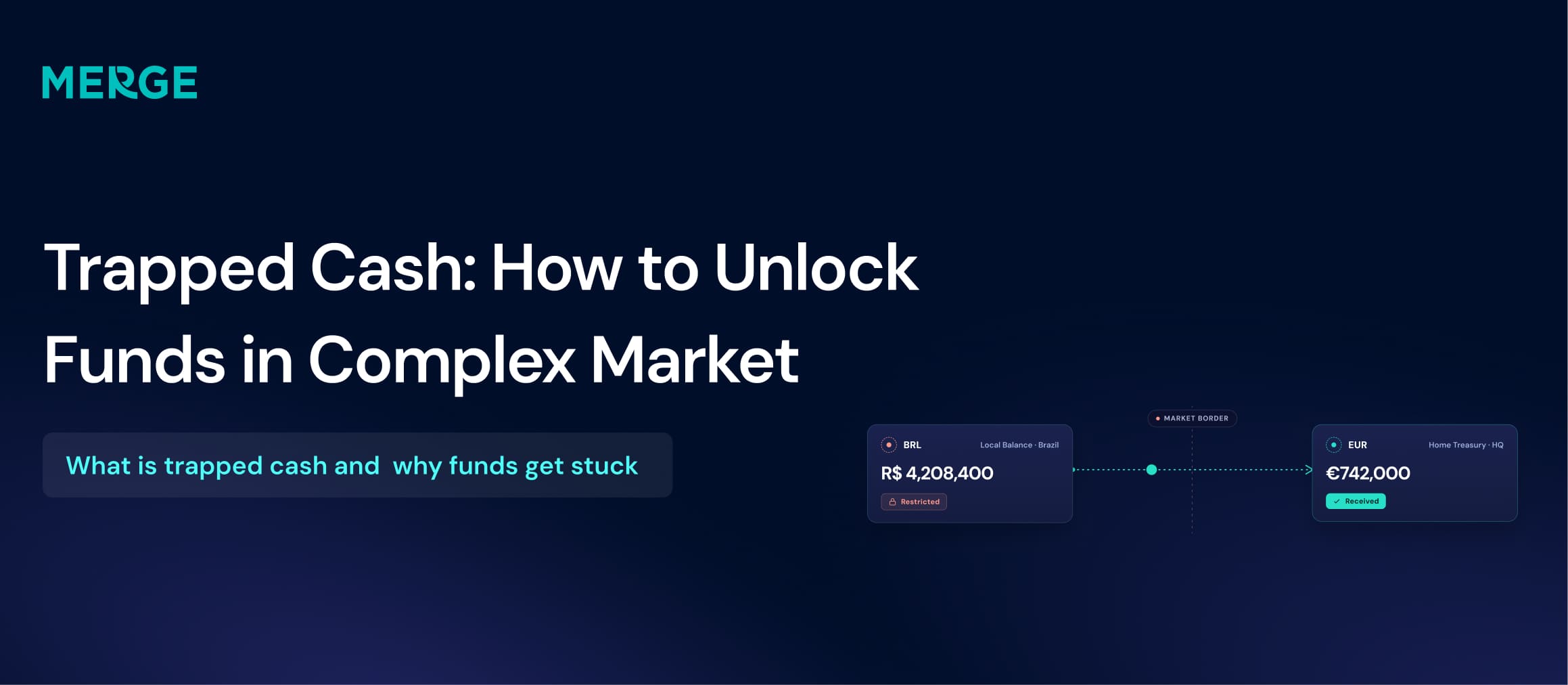
Trapped cash is money a business holds in a particular market or subsidiary that it can’t easily move, convert or repatriate. It usually results from capital controls, illiquid or restricted currencies, limited banking access or fragmented payment rails, leaving balances idle instead of working for the wider group.
Many corporates operate across dozens of markets. The Economist Impact survey found that Latin America (38%), Asia‑Pacific (33%) and sub‑Saharan Africa (26%) are the regions where treasurers face the greatest difficulty moving funds. Emerging economies now account for roughly half of global GDP, and some multinationals hold a quarter or more of their liquidity in these markets. When controls prevent money from leaving the country, cash becomes trapped.
Why Does Cash Get Trapped in Complex Markets?
Several factors can prevent businesses from moving funds freely across borders, particularly in emerging and highly regulated markets.
Capital Controls and Repatriation Limits
Some governments restrict how much money can leave their country. They may cap dividend payments, require a lengthy approval process or insist that foreign companies reinvest earnings locally. According to a survey of treasurers, documentation and regulatory hurdles are the single biggest obstacle to moving cash out of restricted markets (82%), followed by central bank foreign‑exchange controls (72%) and high withholding taxes (41%). These rules slow or block repatriation entirely.
Illiquid or Restricted Currencies
Not all currencies are freely convertible. Some are difficult to trade or settle outside the issuing country. The Bank for International Settlements notes that CLS (the global FX settlement system) covers only 18 currencies, leaving about one‑third of daily foreign‑exchange flows exposed to settlement risk.
Illiquid currencies often have wide bid–ask spreads and low trading volume, which makes them costly to convert. Citi’s restricted‑cash framework classifies some markets, such as Angola, Argentina and Egypt, as “truly trapped” because hard currency reserves are scarce and repatriation may be impossible.
Limited Banking Access and Fragmented Payment Rails
Cash can also get stuck because the underlying payment infrastructure is fragmented. The Bank of England explains that cross‑border payments travel through chains of correspondent banks; the more intermediaries involved, the slower and more expensive the transaction.
For rare currency pairs, payments may require several correspondent banks, with fees deducted at each stage. In some markets, local banking systems do not connect to the global network at all. Treasury teams must maintain balances across multiple banks and currencies to guarantee payments, tying up working capital.
Compliance and Documentation Barriers
Regulation protects financial systems, but inconsistent rules across jurisdictions add friction. Banks must perform anti‑money‑laundering checks, sanctions screening and other regulatory reviews. Each additional compliance check increases cost and delay; incomplete paperwork can cause payments to be rejected entirely. Treasurers surveyed by the Economist Impact group said documentation requirements and “know your customer” procedures were the biggest reasons cash remains locked in emerging markets. Even routine intra‑group dividends may require approval from local tax and investment authorities.
The Real Cost of Trapped Cash
Trapped money isn’t visible on a P&L, but it has a clear impact on the balance sheet and on growth. Idle balances mean money that could be used to fund growth or reduce debt sits unused. More than $27 trillion is tied up in nostro and vostro accounts, liquidity that banks hold to pre‑fund cross‑border payments. Cross‑border flows represent only about 17% of global payment volume but account for 27% of fee revenue (around $200 billion a year).
Another hidden cost is currency erosion. When cash sits in a volatile currency, its value can erode quickly. FX risk was cited as the most critical economic exposure by 83% of treasurers in PwC’s 2025 Global Treasury Survey. If businesses cannot convert funds when they need to, they may suffer losses when exchange rates move against them.
Over‑funding subsidiaries is another consequence. To avoid running out of cash locally, parent companies often keep extra funds in restricted markets. This ties up working capital and reduces overall return on cash. Fragmented systems and poor visibility also make it harder for treasury teams to plan and invest group liquidity efficiently.
Finally, trapped liquidity slows growth. Cross-border payments can take several days and cost up to ten times more than a domestic payment. Long settlement times and high fees discourage investment and trade. Businesses may forego opportunities in markets where they cannot move money quickly and predictably.
How Businesses Unlock Trapped Cash Today
Businesses use a mix of treasury structures, banking arrangements, and newer payment infrastructure to reduce money trapped and improve liquidity.
In‑Country Deployment and Reinvestment
One option is to use the trapped funds locally, for growth, operations or acquisitions. When money cannot leave a country, businesses often reinvest profits in local production, research or infrastructure. This keeps the funds productive when they can’t be repatriated. However, it doesn’t improve overall group liquidity or reduce FX exposure. Companies must still maintain central oversight to avoid over‑investment in markets that may later face devaluation or political risk.
Netting and Intercompany Settlement
Many corporate groups offset payables and receivables between subsidiaries to reduce the amount of cash that needs to move. In a netting structure, each entity reports its positions in multiple currencies; the central treasury then calculates a single net payment for each participant. Netting can significantly lower transaction volumes and FX costs. It works best for entities that trade frequently with one another and can be complemented by intercompany loans or in‑house banks. PwC’s survey reports that top‑performing treasuries are adopting in‑house banks, real‑time liquidity tools and centralised payment models to unlock trapped cash and improve working capital efficiency.
Traditional Correspondent‑Banking Transfers (and Their Limits)
Modern Rails: Local Payment Networks + Stablecoin Settlement
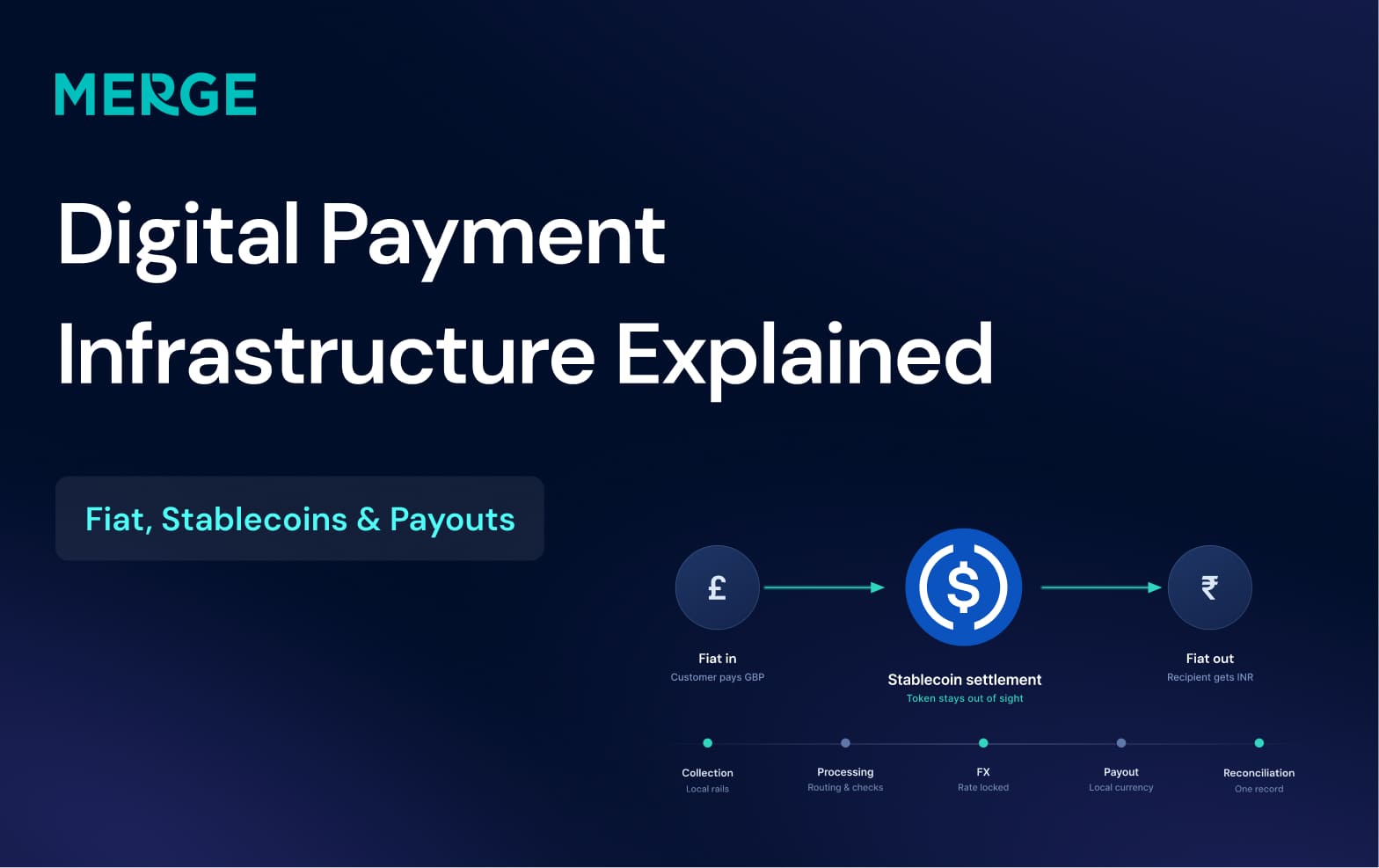
Newer payment infrastructure combines local real‑time payment networks with stablecoin settlement in the middle. Domestic payment systems, like ACH, SEPA, PIX, Faster Payments or UPI, collect and pay out in local currency. Between those endpoints, digital assets can transfer value 24/7 on a shared ledger.
Network fees for stablecoin transfers are just a few cents, compared with an average cost of about 6.5% for conventional cross‑border transfers. Because value moves continuously, funds aren’t trapped waiting for banking hours or pre‑funding windows. Businesses can convert currency only when needed, reducing FX risk, and keep working capital centralised. Regulatory clarity has improved too: the EU’s Markets in Crypto‑assets (MiCA) framework and similar regulations enable corporate treasurers to use stablecoin settlement within a compliant environment.
What to Look for in a Trapped‑Cash Solution
When evaluating solutions for freeing trapped cash, treasurers should focus on a few core capabilities:
How Merge Helps Move Funds Across Complex Markets
Merge combines stablecoin-based payments with local fiat payment networks. Both sides continue to transact in fiat, while stablecoins move value in between. Merge only operates in countries where the local regulatory framework allows this activity, so businesses can expand across supported markets without changing how they collect or pay out funds.
Collect Locally, Pay Out Globally
Merge connects to local instant payment rails worldwide. Businesses can collect funds through domestic bank payment networks such as ACH in the US, SEPA in Europe, PIX in Brazil and Faster Payments in the UK. Automated reconciliation and reporting help match receivables quickly, while 24/7 settlement reduces reliance on banking hours. Once funds are collected, they can be paid out in local currency through the same platform.
Bridging Local Currencies Across Borders
Both sides of a transaction use local fiat rails, while value moves between them using stablecoins. This means neither party needs to hold or manage digital assets directly. Businesses fund a single fiat account; Merge converts to a stablecoin internally, moves value across its digital ledger and settles back into local fiat at the destination. Because the stablecoin leg runs on a 24/7 digital network, settlement can occur at any time, improving liquidity.
Built‑In Compliance
Compliance is embedded into every transaction. Merge handles KYC/KYB onboarding, transaction monitoring, politically exposed person (PEP) screening, sanctions checks and other regulatory workflows in the background. This removes the need to manage multiple compliance vendors and ensures each transfer aligns with local capital‑control and sanctions rules.
One Platform for Multi-Market Money Movement
Treasury teams can open accounts, initiate swaps and trigger payouts through one unified integration, without managing numerous banking relationships. The API offers real‑time visibility into balances, rates and transaction status. It also supports programmatic rules for sweeps and split payments, simplifying liquidity management across subsidiaries.
Reconciliation and Sub‑Accounts for Multi‑Market Visibility
Merge provides dedicated sub‑accounts by client or transaction type. This keeps funds segregated and traceable across markets. An intelligent reconciliation engine matches incoming and outgoing payments automatically. Treasury teams can configure rules for sweeps, so idle balances are sent back to the centre or invested. Segregated sub‑accounts also support client segregation for marketplaces and payment service providers.
Taking Control of Trapped Cash
Trapped cash is more than an accounting footnote. It ties up working capital, exposes businesses to currency swings and slows growth. Traditional correspondent‑banking models force treasurers to pre‑fund accounts and accept long settlement times and high fees. Modern infrastructure offers a way forward. By combining stablecoin rails with local payment networks and built‑in compliance, Merge helps businesses collect locally, pay out globally and regain control of their liquidity.
Ready to unlock trapped cash and strengthen your group liquidity? Talk to Merge or explore the API to see how our regulated platform can help your business collect locally and pay out globally within a single, efficient flow.
FAQ
What is trapped cash?

Trapped cash is money a business holds in a particular market or subsidiary that it can’t easily move, convert or repatriate. It usually results from capital controls, illiquid or restricted currencies, limited banking access or fragmented payment rails, leaving balances idle instead of working for the wider group.
Why does cash get trapped in complex markets?
Funds get trapped when local rules restrict moving money out, when a currency is illiquid or hard to convert, when banking access is limited or when payment rails are fragmented and slow. Each barrier adds documentation, delay and cost, so cash sits in‑country rather than reaching the parent business.
What is cash trapping in a business context?
In corporate treasury, cash trapping refers to liquidity becoming stuck in a market it can’t efficiently leave. Unlike everyday budgeting uses of the term, treasury cash trapping is about cross‑border constraints, capital controls, restricted currencies, limited banking access and repatriation rules that prevent a company from deploying its own funds where they’re needed.
How can businesses unlock trapped cash?
Common approaches include using the funds locally for operations or growth, netting and intercompany settlement, and moving to modern payment infrastructure. Solutions like Merge connect to local payment rails and use stablecoin settlement in between, helping businesses collect locally and pay out globally, within a single, compliant flow.
Does moving funds across complex markets stay compliant?
It should. Any trapped‑cash solution must operate within local capital‑control and sanctions rules. Merge operates as a Virtual Asset Service Provider (VASP) regulated by the AMF (Autorité des marchés financiers) in France and builds KYC/KYB, PEP screening, sanctions checks and transaction monitoring into every transaction.
Disclaimer: This content is intended for informational purposes only. It should not be considered financial, legal, or operational advice. Businesses should evaluate their own compliance, regulatory, and infrastructure requirements before implementing payment solutions.