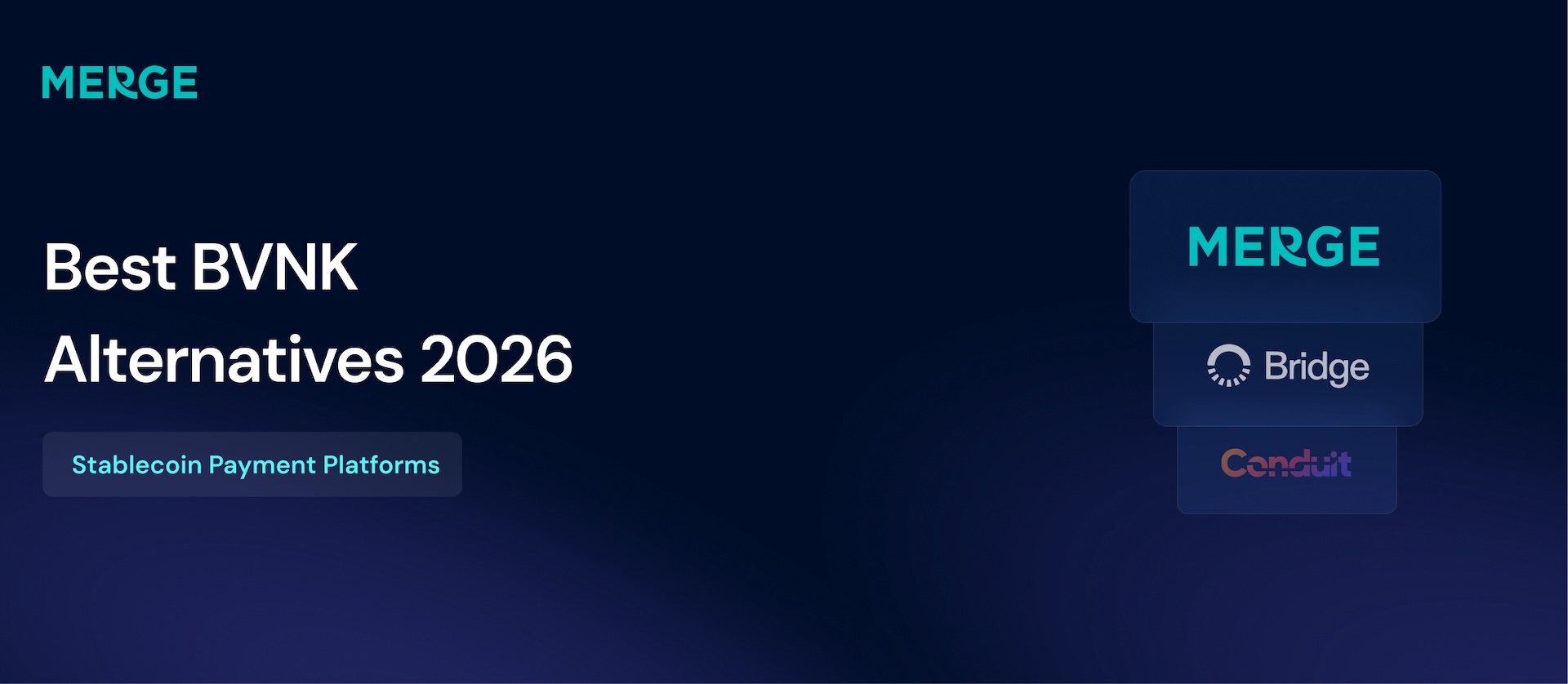


Best BVNK Alternatives for Stablecoin-Powered Payments in 2026
- Merge is the closest single-layer alternative for regulated B2B payments. It combines named fiat accounts, real named IBANs, local payment rails and stablecoin settlement under one regulated API.
- Bridge, Conduit, Fipto, Sphere and Noah each do the same collect, settle and pay out job in a different shape: product breadth, emerging-market corridors, EU-regulated payments and crypto-native APIs.
- The right provider depends on the full payment flow. Licensing, fiat access, account structure and stablecoin support usually matter more than the number of supported tokens.
Stablecoin payments have moved past small trials. McKinsey estimates that identifiable payment activity reached about $390 billion in 2025, more than twice the 2024 figure. That number strips out most of the exchange trading and wallet activity found in headline blockchain totals.
This growth has widened the market for stablecoin payment providers. BVNK remains one of the main names, and in March 2026 Mastercard agreed to acquire it for up to $1.8 billion. It is still not the right platform for every fintech, payment provider or enterprise.
The best BVNK alternatives in 2026 depend on the job your payment stack must perform. Merge fits companies that need regulated fiat and stablecoin infrastructure in one integration. Bridge offers broad product building blocks. Conduit and Noah focus on emerging-market corridors. Fipto is a fully EU-regulated option. Sphere suits crypto-native, API-first teams.
Teams choosing stablecoin payment solutions for businesses in 2026 should start with the operating model. Do your customers pay in fiat? Do recipients need local currency? Must accounts carry the end customer name? Does your company want to hold stablecoins, or use them only during settlement?
What Is BVNK?
BVNK is an enterprise stablecoin infrastructure company. Its platform covers fiat and stablecoin payments, wallets, custody, liquidity and payment orchestration. It reports support for onboarding businesses across more than 130 countries and more than 25 licences and regulatory approvals.
Mastercard agreed to acquire BVNK in March 2026. The stated purchase price is up to $1.8 billion, including contingent payments. BVNK said it would continue operating with an autonomous team.
How Does BVNK Work?
BVNK connects fiat payment rails with blockchain settlement. A business can collect fiat, convert it into a stablecoin, move that value on-chain and convert it back into fiat at the destination. It can also support direct stablecoin deposits and payouts.
Its documentation lists EURC, USDG and USDC across several networks. USDC support includes Arbitrum, Base, Ethereum, Polygon and Solana. Product access changes by customer location. BVNK ended USDT and PYUSD support for EEA-based customers in February 2026 under its reading of MiCA requirements.
That regional difference matters during provider selection. A global support page does not always describe the assets available to your own legal entity.
What Are Stablecoins, and How Do Stablecoins Work?
Stablecoins are digital tokens designed to track the value of another asset. Most payment-focused stablecoins track the US dollar or euro. The issuer usually holds cash, government securities or other reserve assets against the tokens in circulation.
The Bank of England describes the basic structure in three parts. A company issues the token. It holds assets linked to the reference currency. Users then transfer the token across a blockchain network.
In cross-border payments, the stablecoin often sits in the middle of the transaction. The sender pays in GBP, EUR, USD or another fiat currency. The payment provider converts the funds into USDC, USDT or another supported token. Blockchain settlement moves the token to the destination side. An off-ramp converts the token into the recipient local currency. A domestic rail then delivers the payment to the recipient account.
The company does not need to hold stablecoins on its balance sheet in this model. The token acts as a settlement instrument between the two fiat legs. This structure is often called stablecoin settlement for B2B payments, and it can cut the number of intermediaries in a cross-border transfer.
Why Businesses Compare BVNK Alternatives?
Companies rarely replace a payment provider over one feature. The decision usually follows a broader change in product design or operating needs. Common triggers include:
- The business needs named customer accounts or dedicated IBANs.
- A required stablecoin is not available in the customer region.
- The company wants direct access to domestic fiat rails.
- Finance teams need cleaner reconciliation data.
- The platform wants less custody exposure.
- The existing API does not support the planned account structure.
- The company needs stronger corridor coverage in Africa, Latin America, Asia or the Middle East.
- Procurement teams require a different licence or safeguarding model.
These are practical reasons to review BVNK competitors. They do not suggest that BVNK is unreliable. A provider can work well and still be a poor match for a new product.
Top BVNK Alternatives in 2026
1. Merge: The Regulated Settlement Layer
Merge is the closest fit for businesses that want one regulated layer across fiat accounts, domestic payment rails and stablecoin settlement.
Buyers of stablecoin payment infrastructure usually face two options that each carry a cost. One is a single managed provider whose asset and account model is fixed and can change by region. BVNK ending USDT and PYUSD for EEA customers is an example of that risk. The other is a build-your-own toolkit, where custody, liquidity, compliance and payout partners are yours to assemble and maintain. Merge sits between the two. It gives one regulated perimeter and one API across the whole flow, without pushing that integration work onto your team.
Merge combines stablecoin settlement and fiat payment rails into a single API. It lists EUR, GBP and USD accounts and support for more than 60 currencies, with local real-time rails across the UK, Europe, Brazil and India. It operates under a French EMI licence from the ACPR and a French digital-asset (VASP) registration with the AMF. KYB, transaction monitoring and sanctions screening form part of payment execution.
Merge supports USDC and USDT. The payment model can collect fiat through local rails, use a stablecoin as the settlement medium and pay out local fiat at the destination.
Named accounts are the clearest difference. Merge issues real, named EUR IBANs in the end user name rather than pooled virtual accounts, alongside named sub-accounts for a counterparty or business entity. Each account maps to a distinct payment flow, which gives finance teams cleaner reconciliation data and clearer fund segregation.
The stablecoin stays underneath the product. Customers pay and receive in fiat, and the business does not have to hold stablecoins or present a crypto experience to its own users. That structure lets a finance and compliance team place Merge inside an existing control environment.
At a glance:
- Best fit: Regulated B2B cross-border payments
- Coverage: 60+ currencies; local real-time rails across the UK, Europe, Brazil and India
- Chains and stablecoins: USDC and USDT
- Fiat rails: EUR, GBP and USD accounts; SEPA, SEPA Instant, Faster Payments, CHAPS and SWIFT
- Named accounts: Real named EUR IBANs in the end user name (not virtual), plus named sub-accounts
- Regulatory: French EMI licence (ACPR) and digital-asset VASP registration (AMF)
Best for: fintechs and payment providers, marketplaces, global payroll platforms, corporate treasury teams, cross-border B2B payments, and companies that need named accounts.
Main strength: Merge joins stablecoin settlement, named fiat accounts and domestic payout access in one regulated layer.
2. Bridge: Best for Product Breadth
Bridge, a Stripe company, offers modular infrastructure for moving, storing and accepting stablecoins. Its products cover orchestration, wallets, virtual accounts, stablecoin issuance and card programmes.
The orchestration API supports fiat-to-fiat, fiat-to-stablecoin and stablecoin-to-fiat transfers. Bridge lists USD, GBP, EUR, MXN, COP and other currencies. It supports USDC, USDT and Bridge-issued stablecoins across more than ten blockchains. Some assets remain restricted in the EEA.
Bridge works well for companies building a wider financial product. A team can combine virtual accounts, custodial wallets and stablecoin-linked Visa cards under related APIs.
The OCC gave Bridge National Trust Bank preliminary conditional approval in February 2026. That approval is not the same as final authorisation to commence trust-bank business. Final approval remains subject to the OCC pre-opening requirements.
At a glance:
- Best fit: Fintech products needing wallets, cards or issuance
- Coverage: US and EU focus, with wider reach through Stripe
- Chains and stablecoins: USDC, USDT and Bridge-issued, 10+ chains
- Fiat rails: USD, GBP, EUR, MXN, COP and others
- Named accounts: Virtual accounts
- Regulatory: Stripe company; OCC preliminary conditional approval for Bridge National Trust Bank (February 2026, not final)
Best for: neobanks, wallet products, stablecoin card programmes, platforms issuing a branded stablecoin, US-focused fintech infrastructure, products already using Stripe.
3. Conduit: Best for Emerging-Market Corridors
Conduit is a stablecoin-powered cross-border payment platform for businesses that operate across emerging markets. It combines bank rails with blockchain settlement so a company can collect, hold and pay out across fiat and stablecoins.
Conduit reaches more than 100 countries through bank and rail partners, with active corridors across Latin America and Africa. Named markets include Mexico, Brazil, Colombia, Nigeria and Kenya. It supports USDC and USDT, and pays out in more than fifteen fiat currencies through rails such as Pix, SEPA, SWIFT, ACH and Fedwire.
In December 2025 Conduit added multicurrency virtual accounts with IBANs. A platform can issue these accounts to its own end customers, each backed by a segregated account at a regulated bank. Conduit is registered as a money services business with FinCEN and with FINTRAC in Canada, and provides payment services through licensed bank partners rather than as a bank itself.
At a glance:
- Best fit: Emerging-market corridor payments (Africa, LATAM)
- Coverage: Reaches 100+ countries through bank and rail partners; active corridors include Mexico, Brazil, Colombia, Nigeria and Kenya
- Chains and stablecoins: USDC and USDT (Ethereum, Tron, Polygon)
- Fiat rails: 15+ payout currencies; USD, EUR and GBP balances; Pix, SEPA, SWIFT, ACH, Fedwire
- Named accounts: Multicurrency virtual accounts with IBANs, issuable to end customers, backed by segregated bank accounts
- Regulatory: US MSB registered with FinCEN and with FINTRAC (Canada); services through licensed bank partners, not a bank itself
Best for: import and export businesses, marketplaces and fintechs moving money into Africa and Latin America, supplier payouts and payroll in emerging markets, platforms issuing accounts to their own customers.
Main strength: Emerging-market corridor coverage with customer-issuable virtual accounts.
4. Fipto: Best for EU-Regulated Payments
Fipto is a French, EU-regulated stablecoin payment provider for payment service providers, brokers and enterprises. It follows the same collect, convert and pay out model, with fiat accounts on one side and stablecoin settlement in the middle.
Fipto holds two EU licences. It operates as a Payment Institution authorised by the ACPR in France, and in January 2026 it received a full MiCA CASP authorisation from the AMF. It described itself as the first provider in Europe to hold both. That dual status makes it a direct regulated peer for teams that want one European entity across fiat and crypto.
Fipto supports USDC and EURC across Ethereum, Base, Polygon, Arbitrum and Optimism. It offers EUR and USD accounts through SEPA Instant, SEPA and SWIFT, with named IBANs that show the business name and unlimited virtual IBANs for reconciliation. Its published currency range is narrower than BVNK, centred on EUR and USD.
At a glance:
- Best fit: EU-regulated PSPs, brokers and treasury teams
- Coverage: EEA through EU passporting; global payouts through partners
- Chains and stablecoins: USDC and EURC (Ethereum, Base, Polygon, Arbitrum, Optimism)
- Fiat rails: EUR and USD; SEPA Instant, SEPA and SWIFT, plus on-chain
- Named accounts: Named EUR and USD IBANs plus unlimited virtual IBANs, segregated with banking partners
- Regulatory: EU Payment Institution licence (ACPR, France) and full MiCA CASP authorisation (AMF)
Best for: EU and EEA-focused PSPs, crypto brokers, and enterprise treasury teams that want a fully European regulated partner across fiat and stablecoins.
Main strength: Dual EU licensing across fiat and crypto in one entity.
5. Sphere: Best for Crypto-Native, API-First Teams
Sphere is an API-first stablecoin payments company aimed at crypto-native fintechs and licensed money-transfer operators. It moves value across borders by converting between fiat and stablecoins and settling on-chain.
Sphere supports USDC, USDT and EURC across several blockchains, including Solana, Ethereum, Base, Polygon, Avalanche, Arbitrum and Tron. It settles over SphereNet, a permissioned shared ledger, and exposes the payment flow through developer APIs. Its named fiat coverage is narrower, centred on US dollar, euro and Brazilian real, with live corridors such as BRL to USD.
Sphere offers virtual on-ramp accounts that convert incoming fiat into a chosen stablecoin. It works through local bank and regulated partners rather than a licence of its own, and is backed by Coinbase Ventures and Kraken Ventures. It suits teams that want a developer-led on and off-ramp layer more than broad out-of-the-box fiat coverage.
At a glance:
- Best fit: Crypto-native, API-first fintechs and money-transfer operators
- Coverage: Live corridors include BRL to USD and USD to EUR, with wider payout reach through SWIFT
- Chains and stablecoins: USDC, USDT and EURC across Solana, Ethereum, Base, Polygon, Avalanche, Arbitrum and Tron; settles over SphereNet
- Fiat rails: USD, EUR and BRL; ACH, wire, SEPA and Pix
- Named accounts: Virtual on-ramp accounts in USD and EUR
- Regulatory: Works through local bank and regulated partners; no own licence publicly confirmed. Backed by Coinbase Ventures and Kraken Ventures
Best for: crypto-native fintechs, PSPs and licensed money-transfer operators that want an API-first on and off-ramp and multi-chain settlement layer.
Main strength: Developer-first, multi-chain settlement for crypto-native teams.
6. Noah: Best for Emerging-Market Pay-In and Payout
Noah is a stablecoin-native payments infrastructure provider with a single API for fiat pay-in, stablecoin settlement and local fiat payout. Its founding team includes former Adyen leadership.
Noah issues named virtual bank accounts across major currencies that convert incoming fiat into a stablecoin, then pays out through local rails. It reports local off-ramps in more than 70 countries and payouts in more than 30 fiat currencies, with strength in emerging markets across Africa and Latin America. Named markets include Nigeria, Kenya and Colombia.
Noah supports USDC and USDT, working with issuers Circle and Paxos. Compliance is handled in the platform, with KYC and KYB onboarding, sanctions screening and Travel Rule support. It holds a US money-transmitter registration and operates in Europe through sponsor banks.
At a glance:
- Best fit: Emerging-market pay-in and payout (Africa, LATAM, Europe)
- Coverage: Local off-ramps in 70+ countries; 30+ payout currencies
- Chains and stablecoins: USDC and USDT (issuers Circle and Paxos)
- Fiat rails: Named virtual accounts in USD, EUR and other majors via bank transfer and SWIFT; payouts via local bank transfer, Mobile Money and regional methods
- Named accounts: Named virtual bank accounts with hosted KYC and KYB
- Regulatory: US money-transmitter registration (NMLS); operates in Europe through sponsor banks
Best for: fintechs, neobanks, payroll providers and enterprises needing stablecoin-settled payments into emerging-market corridors with compliance handled.
Main strength: Emerging-market payout reach with compliance built in.
BVNK Versus the Alternatives
How to Choose an Alternative to BVNK
Choosing the right provider starts with a clear view of the payment flow, regulatory scope, technical needs and operating overhead.
Step 1: Map the Payment Flow
Write down the actual movement of funds. For example: a customer pays EUR through SEPA. Funds enter a named account. The provider converts EUR into USDC. USDC settles on-chain. The provider converts it into MXN. The recipient receives MXN through a local bank rail.
This map reveals each required service. It prevents teams from buying a payment processor that covers only the on-chain step.
Step 2: Set the Regulatory Requirements
List every country involved in customer onboarding, fiat collection, stablecoin conversion, wallet activity, payment settlement and final fiat delivery. Ask each provider to name the contracting entity, licence and safeguarding structure. Do not accept a group-wide list without a product-level explanation.
MiCA has applied fully across the EU since December 2024. Its stablecoin provisions started in June 2024. The European Commission opened a MiCA review consultation in May 2026, so technical rules can keep changing. The UK created a wider cryptoasset regime in February 2026, with commencement planned for October 2027. The government is still working on how stablecoin payment services will sit beside the new crypto perimeter.
Step 3: Test the API Integration
Your sandbox test should cover more than a successful transfer. Test customer and business onboarding, account creation, quote expiry, currency conversion, webhook retries, duplicate payment protection, failed payouts, returned fiat payments, unsupported wallet networks, compliance holds, manual review, reconciliation exports and historical transaction retrieval. Ask for the expected API integration timeline and the support model during launch.
Step 4: Weigh the Operating Overhead
Look past the headline integration. A provider that looks simple at signup can add work later through manual reconciliation, failed payments and support cases. Estimate the staff time each option needs across three real corridors. A cleaner account structure and structured reconciliation data can remove hours of manual work each week.
Step 5: Plan the Migration
Companies researching how to replace BVNK payment processing should avoid a single cutover date. A safer transition uses four stages: build and test the new integration, route a small share of low-risk payments to the new provider, compare delivery time, failure rates and reconciliation, then move the remaining volume after the new flow meets agreed targets.
Keep the old integration active during the first production period. This creates a route back if an unexpected corridor issue appears.
Choose the Payment Structure Before the Provider
The strongest BVNK alternative is the one that covers the complete flow. Merge stands out for regulated B2B payments that cross fiat and stablecoin rails, with real named accounts. Bridge offers wider product components. Conduit and Noah focus on emerging-market corridors. Fipto is the other EU dual-licensed option. Sphere suits crypto-native, API-first teams.
Start with one real corridor. Map every account, conversion, compliance check and payout step. Then ask each provider to demonstrate that flow.
For companies that need named accounts, local fiat rails, stablecoin settlement and finance-ready payment data through one integration, speak to Merge.
FAQ
Is BVNK still viable in 2026, or should I switch?

Yes. BVNK remains viable in 2026. It holds a MiCA CASP licence and has agreed to be acquired by Mastercard. Its platform supports enterprise stablecoin payments, wallets, fiat rails and orchestration. Switching makes sense when corridor coverage, named-account needs, custody preferences or regional stablecoin limits no longer fit. Base the decision on transaction data and operating needs.
Do these BVNK alternatives require my business to hold stablecoins?
No. Most of these providers can use a stablecoin only as the settlement medium between two fiat legs. The customer pays in fiat and the recipient is paid in fiat, while the stablecoin moves value on-chain in the middle. Providers such as Merge are built so the business does not hold stablecoins or expose a crypto experience to end users. Confirm the model, since some products also support direct stablecoin balances.
Can I use multiple BVNK alternatives simultaneously?
Yes. A company can use several stablecoin payment providers at once. One may handle European fiat collection, another wallet payouts, and a third difficult corridors or failover. This reduces dependence on one provider but adds API, compliance, reconciliation and liquidity work. Use clear routing rules, record provider ownership for each payment, and add idempotency controls to prevent duplicate transactions during retries.
How long does it take to migrate from BVNK to an alternative?
A focused migration can take four to eight weeks. A broader stablecoin settlement switchover may take several months. The work covers requirements, provider onboarding, API integration, testing and controlled rollout. Legal review, KYB, account opening and corridor approval can extend the schedule. Timing depends on account structures, customer migration, historical data, supported countries and the amount of production testing required.
Which BVNK alternative supports the widest stablecoin and chain range?
Among these providers, Bridge supports major stablecoins across more than ten blockchains, and Sphere spans several chains with USDC, USDT and EURC. Conduit, Noah and Merge focus on USDC and USDT, and Fipto on USDC and EURC. Choose by regional rules, liquidity, demand and network support, not token count alone.
Disclaimer: This content is intended for informational purposes only. It should not be considered financial, legal, or operational advice. Businesses should evaluate their own compliance, regulatory, and infrastructure requirements before implementing payment solutions.


Ready to see what Merge can do for you?
Related Articles