PLATFORM

Stablecoin Payments Infrastructure

Stablecoin payments are cross-border transfers that settle in seconds using regulated, fiat-backed tokens, but typically require users to transact in stablecoins.

Merge combines stablecoin rails with local fiat payment networks, enabling seamless global transfers while senders and recipients continue to transact in fiat without changing how they operate.
Backed by the best

The Cost of Correspondent Banking in Cross-border Payments

Stablecoin cross-border payments don’t require belief in crypto; they require belief in arithmetic. The difference between correspondent banking costs and regulated stablecoin settlement is not incremental. It is structural, predictable, and measurable across every transaction.

Settlement delay

Every day that funds are in transit is a day capital is not deployed. For businesses running multi-currency flows or supplier payouts, this directly impacts liquidity and growth.

Hidden intermediary fees

Each correspondent bank adds fees at every hop. Most finance teams only see the total cost after reconciliation, if they see it at all.

FX unpredictability

Locking exchange rates across multi-day settlement windows is difficult. The amount quoted and the amount received often diverge, impacting margins.

Operational overhead

Manual reconciliation, cut-off tracking, and failed payment handling. The administrative burden of correspondent banking is significant and rarely measured accurately.

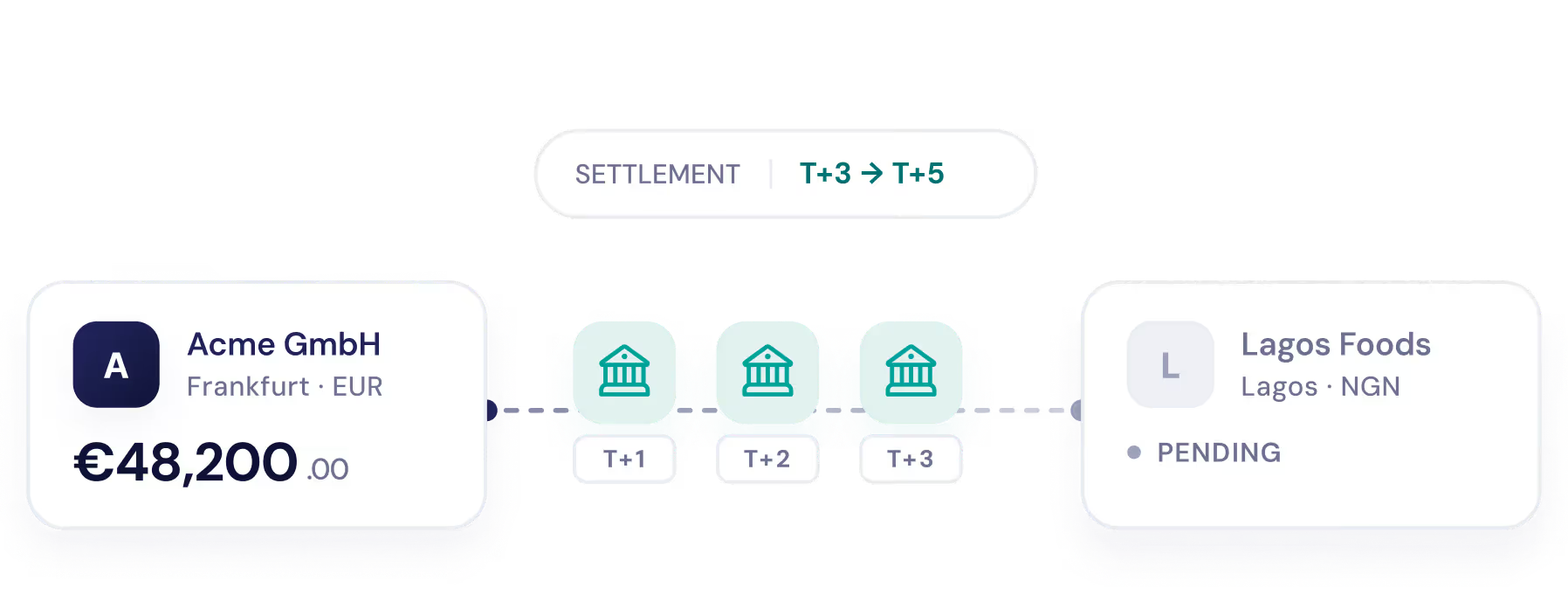
Correspondent banking: cross-border payments

T+3 to T+5 settlement window. Continuous FX exposure. Limited visibility until funds are delivered.

Financial Impact of Stablecoin Payment Infrastructure on Treasury

These are not product features. They are the financial and operational outcomes of moving from a correspondent banking model to stablecoin payments, expressed in terms that your treasury and finance teams can measure and act on.

Working Capital is no Longer Locked in Transit

With a stablecoin payment infrastructure, settlement becomes near-instant. Capital that previously sat idle for days returns to your balance sheet continuously, improving liquidity across every cross-border payment cycle.
Settlement finality: T+0

Payment Operations Eliminate Failure Uncertainty

On-chain settlement is deterministic. Transactions either complete or revert; there is no pending state or routing ambiguity. Reconciliation shifts from manual investigation to structured reporting.
Failed payment rate: Near zero

Cross-Border Payment Fees Become Predictable and Transparent

No intermediary deductions, no per-hop charges, no FX spread uncertainty. International payment stablecoin pricing is fixed before execution, not discovered after reconciliation.
Flat per transaction: 0.1–0.5%

Treasury Operates on Real-Time Settlement Data

Every transaction is recorded on an immutable ledger. Finance teams gain precise timestamps, confirmations and full traceability, instantly, not at month-end close.
Audit trail: Full, always

Ready to See It in Action?

Talk to the Merge team and we'll configure the payment infrastructure that fits your use case.

Which Businesses Use a Stablecoin Payments Platform

Stablecoin payments for business solve different cost and infrastructure problems depending on how you move money. Here is what switching to stablecoin settlement looks like in practice across three business types carrying real cross-border payment costs today.

Fintechs & PSPs

Fintechs' stablecoin settlement removes the correspondent banking layer from high-frequency, multi-corridor payouts without changing the user experience.
Settlement: near-instant
Costs: no hidden intermediary fees or opaque FX spreads
Reconciliation: real-time and auditable

Marketplaces

A cross-border payment solution that scales without complexity. Expanding into new markets adds banks, processes and fragmentation. Regulated crypto infrastructure replaces this with a single, consistent settlement rail.
Corridors supported: Globally
Banking relationships required: One integration
Payout latency: Near-instant, 24/7

Digital Assets

Use regulated stablecoin infrastructure that fits within your compliance framework, with KYB, transaction monitoring, and sanctions screening built into the payment layer.
Compliance: KYB, transaction monitoring, and sanctions screening built in
Settlement rails: Regulated infrastructure, not unhosted wallet flows
Regulatory alignment: Fits existing controls and reporting standards

Financial Institutions

Replace fragmented correspondent chains with a more direct settlement rail. Merge handles KYC/KYB, transaction monitoring, and PEP and sanctions screening in the background.
Settlement rail: A more direct alternative to correspondent chains
Compliance workflows: KYC/KYB, PEP screening, and sanctions checks automated
Visibility: Real-time transaction traceability

Payroll

Run global payroll across corridors with consistent settlement timelines, predictable costs, and less reconciliation work.
Settlement: Consistent timelines across corridors
Costs: Transparent pricing, no hidden intermediary charges
Reconciliation: Automated, with less manual work

AI Platforms

Embed global payments directly into AI-driven products, enabling monetization, subscriptions, and cross-border transactions without disrupting the user experience.
Settlement: Near-instant across supported corridors
Costs: Transparent pricing with no hidden FX spreads
Reconciliation: Real-time and fully auditable

Commodity Trading

Streamline cross-border settlement for commodity transactions with faster payment flows, reduced reliance on intermediaries, and improved capital efficiency.
Settlement speed: Accelerated compared to traditional rails
Counterparty risk: Reduced through direct settlement
Liquidity: Optimised with faster capital turnover

Brokerages

Enable seamless funding, withdrawals, and global trading operations with consistent settlement timelines and simplified cross-border flows.
Funding: Faster account top-ups across regions
Settlement: Predictable timelines for trades and withdrawals
Reconciliation: Streamlined with automated reporting

B2B Stablecoin Payments Built for Regulated Businesses

Stablecoin payments introduce a new settlement rail. The question is not speed; it is whether your finance and legal teams can approve it.
Merge is structured as a regulated payment infrastructure, not a crypto product. That means stablecoin settlement fits within existing financial controls, reporting standards and audit requirements.

Funds Remain within Regulated Financial Systems

Stablecoin settlement occurs between regulated entities, with fiat on- and off-ramps anchored in traditional banking. Your balance sheet never carries token exposure.

Every Transaction is Fully Traceable from Origin to Settlement

Unlike correspondent banking, where visibility is fragmented, stablecoin settlement produces a complete audit trail at the transaction level, accessible in real time.

Compliance is Embedded at the Payment Layer

KYB, transaction monitoring and sanctions screening are applied automatically. This is not an additional workflow; it is part of how payments are executed.

Reporting Aligns with Existing Finance Processes

Transactions can be reconciled, exported and audited using the same frameworks your team already uses. No parallel systems, no new operational layer.

Ready to Modernise Your Cross‑Border Payments?

Finance leaders choose Merge to remove correspondent banking complexity and move capital at stablecoin speed. Book a demo or talk to us today and see how stablecoin settlement can upgrade your treasury.

FAQ

What are stablecoin payments for business use exactly?

Stablecoin payments are cross‑border transfers that use regulated tokens pegged to fiat currencies to settle funds on‑chain in seconds. Senders pay in local currency, and recipients receive local currency via fiat channels.

How are stablecoin payments different from crypto payments?

Stablecoin payments use tokens pegged 1:1 to fiat currencies, eliminating price volatility. Merge users never hold tokens; funds enter and exit as local fiat. Stablecoins are settlement rails, not investments only.Using stablecoin infrastructure to execute core treasury functions, moving funds, managing liquidity, and running cross-border payments on blockchain rails rather than correspondent banking networks. Settlement is near-instant. Merge delivers this as regulated infrastructure, so enterprises get the benefits without touching the blockchain layer themselves.

Are stablecoin payments regulated under financial law today?

Yes. Merge operates as a Virtual Asset Service Provider (VASP) regulated by the AMF (Autorité des marchés financiers) in France. Every transaction includes automated screening and sanctions checks.

What does stablecoin settlement cost compared to SWIFT?

Merge charges a transparent fees per transaction. Traditional cross-border payments via correspondent banking carry higher costs, more friction, and margin erosion at every step. Stablecoin settlement removes the correspondent chain, hidden spreads, and per-hop intermediary fees.

What is a stablecoin payments platform for business?

A stablecoin payments platform provides infrastructure, compliance, on/off-ramps, multi-currency accounts, and settlement for cross-border payments over stablecoin rails. Merge handles the stack so businesses and users can transact in local fiat.